Monday, December 12, 2005

U.S. Asked To Investigate Awards To ERHC

After having failed to get Nigeria to cooperate with its probe of ERHC Energy, the share price is in a free fall right now as the government of the tiny island nation of Sao Tome and Principe asks the United States to conduct an inquiry into awards of Blocks to the company, according to a Reuters report by Zoe Eisenstein.

Given the influence of ExxonMobil and Anadarko with the Bush Administration - Anadarko VP Greg Pensabene is married to Senate Energy Committee Republican Chief Counsel Judy Pensabene, and both went to school with the probe's initiator, Democrat R. Dobie Langenkamp, at Tulsa University School of Law - the request is likely to be received with open arms.

But how the United States can investigate the bilateral relationship encountered in the Nigeria-Sao Tome Joint Development Zone, except through a possible SEC inquiry aimed at ERHE, an Over-The-Counter Bulletin Board issue, is unknown.

The alleged wrongdoing appears to involve a failure to follow certain rules and procedures set up by the Nigeria-DRSTP Joint Development Authority rather than genuine securities-related issues.

The report does bring up the issue of payments to Sao Tome officials that were widely discussed in 2003. ERHC Energy was obligated to make certain payments to Sao Tome under a contract it signed in March 2003, and those have become controversial time and again as the years pass. The comapny also made a legal campaign contribution to President Fradique de Menezes of $100,000 in 2002. The company has not had any contact with Sao Tome offficials in the Second Round, which started in November 2004, ERHC Energy CEO Ali Memon said.

Nonetheless, the request promises another round of "buying opportunities" and new delays in the signing of PSCs, which were expected in December but now are likely to be delayed for many months.

The Bid has fallen from $0.445 a few hours ago to $0.37 now, wiping out long-awaited and hard-won gains.

At 1:57pm, the Bid was $0.351 and the Ask $0.354. Volume is 5,721,860.

Here is the Reuters account of the probe request:

REUTERS Sao Tome to ask U.S. to probe ERHC oil contracts

By Zoe Eisenstein

SAO TOME, Dec 12 (Reuters) - Sao Tome will ask U.S. authorities to investigate contracts awarded to Houston-based ERHC Energy following a probe into alleged
irregularities in an oil exploration licensing round.

A report by Sao Tome's Attorney General's office said there were repeated suggestions that Nigerian-controlled ERHC made improper payments to officials and their families during the award of oil blocks in a joint development area shared with Nigeria.

"Key officials in the past have been reported to have solicited bribes, and ERHC has provided known benefits to the families of key decision makers," said the report, a copy of which was obtained by Reuters.

"Such payments would be a violation of Sao Tomean law and make the contracts voidable," the report said.

"The office intends to refer this matter to the U.S. Department of Justice and the Securities and Exchange Commission and to seek their assistance in investigating whether violations of U.S. law have occurred."

U.S.-listed ERHC, which Sao Tome says is controlled by Nigerian company Chrome, was the biggest winner from the licensing round for five blocks, gaining the joint control of two blocks and stakes in the three others.

Asked about the report, ERHC President and CEO Ali Memon said his company had acted at all times in consortia with U.S. companies.

"Whatever we have done from the time of the submission of the bids, we have acted in consortium with other major U.S. companies," Memon told Reuters. "ERHC has had no contact with any Sao Tomean officials whatsoever through the bid process."

The round, which concluded in May, was the second held in the Joint Development Zone (JDZ) shared by the two neighbours in

The Nigerian attorney general's office had not cooperated in the probe and no Nigerian officials had testified, the report said.

The preferential rights granted to ERHC would, if executed, result in a loss of $58.6 million in revenues for Sao Tome, the investigation concluded.

Separately, the attorney general's report noted the conditions of ERHC's agreement were so favourable they might violate Sao Tomean law by "alienating" -- signing away control over -- its natural resources.

"Apart from fraud, Sao Tome and Principe should again reexamine whether there are grounds for terminating the contract," the report said.

Expressing concerns over the financial and technical qualifications of some of the companies awarded blocks by the Joint Development Authority (JDA), the inquiry suggested some of their partners might simply withdraw.

"One immediate challenge to the JDA may be the partial collapse of the second round itself," the report said, noting none of the groups awarded blocks had finalised production sharing agreements with the JDA.

The report said top U.S. independent oil producer Devon Energy Corp. and Noble Energy Inc. had already withdrawn from two groups where ERHC was a partner.

The investigation recommended the JDA should simplify the bidding process, making it more transparent and reducing the number of variables open to bidding.

International observers should be invited to observe the process and members of the JDA should be made to disclose any interests, the report concluded.


Next is the latest report available on the same topic, which comes from Oil Daily via the Energy Intelligence Group, publishers of Energy Compass and courtesy of I-Hub poster stockhocker:


Sao Tome Report Slams Upstream Round as 'Seriously Flawed'

Tuesday, December 13, 2005

An investigation by the attorney general of Sao Tome and Principe into the controversial second licensing round held in the Joint Development Zone (JDZ) shared with Nigeria has concluded that the process was "seriously flawed and failed to meet minimum acceptable standards for the award of licenses," Oil Daily can reveal.

In the as-yet-unreleased report -- a copy of which was obtained by Oil Daily -- Attorney General Adelino Pereira criticizes the licensing process and partner Nigeria, stating that the whole process "has been to the financial detriment of Sao Tome … and may be responsible for the inability of the Joint Development Authority (JDA) to actually enter into development agreements with the awardees."

Pereira recommends that the JDA require all block signatories to sign modified production sharing agreements by a fixed date, with awards rendered void if they fail to meet this deadline.

The second bid round for the JDZ was launched in October 2004, and after a long bidding process, contract winners were announced by the Joint Ministerial Council (JMC) in June 2005 -- swiftly followed by the resignation of the Sao Tome prime minister over the bias shown toward Nigerian firms (OD Jun.27,p6). So far no contracts has been signed for any block in the second round, and two US independents, Devon and Noble Energy, have withdrawn from the process.

The round was subject to "serious procedural deficiencies and political manipulation, including the award of interests to many unqualified firms or firms with inferior qualifications, technically and financially," says this month's attorney general's report. It goes on to argue that the manipulation deterred qualified companies from bidding, and diminished the value of any license in the eyes of those that did. Furthermore, awards went to companies that had neither the "technical or financial capacity for deepwater drilling," with no due diligence performed on bidders until after the final awards were determined. The various ties identified in the report "strongly suggest the importance of political and other connections."

The document -- authored by Pereira, with aid from US-based nonprofit organization International Senior Lawyers Project -- says that some companies were given interests in blocks even though they had not been the high bidder, while in other blocks operators' interests were diluted through the "forced partnering" with companies inserted by the JDA. It also says some companies were given the opportunity to rebid during the selection process, and that several JDA and JMC representatives -- from both countries -- "had financial conflicts of interest in the process because they held stock in companies bidding for and receiving awards."

The report confirms suspicions that senior members of the Sao Tome government came under severe pressure from Nigerian representatives to accede to the "insertion" of companies that appeared to be under the control of Nigerian nationals, "some of whom are closely associated with the Nigerian government."

Sources close to the process previously alleged that the Nigerian government -- keen to collect JDZ signature bonuses -- only managed to persuade Sao Tome President Fradique de Menezes to approve the award recommendations by threatening to withhold Sao Tome's share of the signature bonus on Chevron-operated Block 1, the only award in the first licensing round in 2003-04.

However, a number of the "inserted" companies have so far been unable or unwilling to provide the funds needed to advance the negotiation of license agreements with the JDA.

Sao Tome's problems during the second round were exacerbated by the presence of Environmental Remediation Holding Corp. (ERHC) -- a Nigerian-owned, US-listed firm -- and its preferential rights to stakes in six blocks under an earlier bilateral accord between Nigeria and Sao Tome. The report claims ERHC's participation discouraged more qualified companies from bidding because of "reputational, financial and technical concerns," resulting in the loss of nearly $60 million of signature bonus money that would otherwise have gone to the Sao Tome government.

Although previous attempts to nullify the ERHC contract have failed, the attorney general suggests that as "improper payments" or "benefits" to government officials or their families may have helped secure the deal, his office intends to refer the matter to the US Department of Justice and the Securities and Exchange Commission, "to seek their assistance in investigating whether violations of US law have occurred."

In a footnote to the report, Pereira notes that his investigation was based solely on the basis of the JDA documents available to the Sao Tomean authorities and voluntary individual statements. He requested the assistance of the Nigerian attorney general's office, but "no answer was received."

ERHE Up Strongly On Addax, Probe News

News that a payment of $18 million to debt-free ERHC Energy is coming and that the company will get 25 percent more of Block 4 than agreed to with Noble Energy - and a full carry to first oil - is once again lifting ERHE shares, which have traded as high as $0.449 today and now are up $0.028, or 6.8 percent on heavy volume of 1,728,097 shares at 11:08am EST.

The good news? The Addax IPO, which by SEC rules cannot be published in the United States, remains a secret to most of the investment world as it has not yet been reported by Dow Jones or Reuters.

News of the $18 million payment and larger share, along with the end of the probe launched by the government of Sao Tome and Principe into the award of blocks in the Second Licensing Round of the Nigeria-Sao Tome and Principe Joint Development Zone last May 31, has moved the share price about $0.12 since it hit a low of $0.32 just about two weeks ago.

Update, 11:26am EDT: The price is settling back down, with the last sale at $0.435 and the Bid at $0.43. We were tempted to sell some shares at $0.445, but we think there may be yet another surge in price late this afternoon. The most significant gains in the short term will come from a news agency reporting on the Addax IPO, and that could presumably happen anytime between right now and the day the $18 million payment is made.
Update, 12:05pm EDT: The price has improved, and is now at the high of the day $0.45 with the Bid at $0.445. Volume is roughly 2.1 million shares, with Buys running 1,471,942 to Sells of 763,306, and 47,200 undetermined.

Uche Okoro, Democracy Activist And Nigerian Oil Workers' Union Chief, Dead In Saturday's Port Harcourt Air Disaster

Uche Okoro, the powerful president of PENGASSAN, the Nigerian oil workers' union that is a potent force for change in that oil-rich but desperately poor country, is dead.

Okoro was among the victims of a devastating passenger jet crash Saturday that killed all but three of the 110 souls aboard, including all of a group of 75 children heading home from boarding school for the Christmas holidays. Two of the surviving victims are in critical but stable condition.

Okoro was leading a challenge against those who want Nigerian President Olusegun Obasanjo to seek a third presidential term, which is prohibited by the nation's constitution. Obasanjo has repeatedly said he will not seek a third term.

PENGASSAN is a major force for change in local content rules, sure to be an issue as more foreign companies seek stakes in Nigeria's onshore and offshore riches.

Here is the Daily Independent account of Okoro's death:

Okoro, PENGASSAN President, A Victim in Sosoliso Plane Crash
12.12.2005

Labour again was thrown into grief yesterday as information filtered in that the vibrant and colourful President of Petroluen and Natural Gas Senior Staff of Nigeria, PENGASSAN, Uche Okoro, was among those who lost their lives in the Port Harcourt air disaster involving Sosoliso Airlines.

Okoro, who emerged as President about six months ago, was on his way to Port Harcourt to see his family after an official engagement in Abuja. Regarded as a grassroots activist, Okoro started his labour career with the National Union of Petroleum and Natural Gas Workers, where he became President.

Under his tenure, Okoro was at the forefront of the battle against the military, especially during Sani Abacha regime. He left NUPENG when he was promoted in his oil company to a senior staff cadre.

He was overwhelmingly elected as the President of PENGASSAN this year to set the enviable record of being the first unionist to lead two unions in the same industry.

Known to be very committed to democratic principles and values, a few days ago Okoro declared that he would mobilise the oil workers against the speculated third term agenda of President Olusegun Obasanjo.

At the press conference, which turned out to be his last, Okoro declared the agenda not only was a huge joke, but an ambition of few selfish politicians which would never materialise.

He was at the process of unifying the two unions, NUPENG and PENGASSAN, a measure which he declared will strenghten the negotiating capacity of the oil workers.

Sunday, December 11, 2005

ERHC Mailbag: Langenkamp Demurs, Louise Worries, Al Wants A New Contest And Mark Wants To Know

In our mailbag upon our return from the Fla. Democratic Party Conference in Orlando this weekend, we found a note from R. Dobie Langenkamp, who has taken issue with our reporting on the investigation he headed of the May 2005 awards of oil concessions by the Nigeria-Sao Tome and Principe Joint Development Zone.

We reprint it in its entirety below, and extend our deepest regrets to Mr. Langenkamp, a distinguished Democrat and former Assistant Secretary of Energy, if indeed we have wronged him.

We also got a note from a reader who is worried about the article by the Reuters news agency that ran last week in the Houston Chronicle. We also reprint that note, minus the writer's last name (she is from Houston), and add our response along with a link to the article.

First, the note from Mr. Langenkamp. [We have corrected minor typographical errors]:

Dear Mr. Shea:

Your continued disinformation and prevarications regarding my participation in the inquiry into the Second Round Bid process for the STP/Nigerian JDZ is reprehensible and actionable. It is false and you know it to be false.

My institute here at Tulsa has no "Board" much less one on which Exxon and other oil company executives sit. (The Board to which you seem to refer is the Board of the Institute of Energy Law in Plano, Texas. I on behalf of Tulsa University am one of almost 300 members of that Institute. Like Nelpi it is an educational institute wholly engaged in educational programs.) My work on the Report was undertaken by me in my private capacity on a pro bono basis.

I do not have any connection with any of the oil companies involved in either of the bid rounds nor have I communicated with [any] of them directly or indirectly in any respect. To state that my work on this project was on their behalf is preposterous - and defamatory.

This inquiry was undertaken at the STP AG's request by the International Senior Lawyers Project. The report is a product of a team of lawyers of which I am one. For you [as a] stockholder of one of the bidders to allege a conflict of interest on my part is ironic. Beyond that it is insulting and I demand that you make an appropriate retraction.

It is clear that you, not I, have an economic motive in this matter. This makes your persistent defamation a more serious matter.

r.dobie langenkamp

R. Dobie Langenkamp
Director, National Energy-Environment Law & Policy Institute
Professor of Law
University of Tulsa College of Law

Here is the second letter, from Louise [name withheld]:


Check this out Joe....São Tome says it needs Nigerian OK to end flawed oil deals not good news at all.

Louise


ERHC On The Move responds:It is bad news for Sao Tome, Louise, but of course because the deals cannot be cancelled it is bad news for ERHC Energy only in the sense that it leaves their role undetermined and suspect while casting aside the strong possibility of their innocence.

If you read more closely, you may see that while ERHC has always been controversial there is nothing in the President's statement of a $58 or $59-million" loss that appears to relate to ERHC. And despite this bad news, you will have likely noted that our share price has risen sharply.

This was largely due to the publication of terms of the Addax IPO, but partly to the end of the investigation due to Nigeria's non-cooperation, which I have applauded because I suspect different origins than argued by its sponsors [see above].

Many thanks for your readership, Louise, and please stay in touch.

Best,

Joe


In other items, reader Al [name withheld] would like to see another price-guessing contest. Here's his note, and my response:

Earlier this year you started a contest to seek a board member who could closely determine the stock price of ERHE on a predetermined date. I for one would appreciate a comparable contest at your choosing. Your interest would be appreciated.


ERHC On The Move responds:Ironically, Al, I was thinking of that very thing as I drove home from Orlando this afternoon. I recalled the number of times people wrote me and said they didn't like the predictions, and asked me politely not include them anymore in my posts.
The reason I had included them was that I felt the share price had become very predictable, and that investors ought to have the benefit of it.

Rather than go through a contest again, I will tell you what I think the most recent developments cncerning the probe and the Addax deal will mean: I think our stock is going into the $9 range - probably 20 or 30 cents higher, in fact. When? We'll talk about that later.


Best,

Joe

This came from someone named Mark. My reply follows:

Nice reporting today. Will the Reuters news likely help PSCs get done sooner, in your opinion? Have a great weekend.

ERHC On The Move responds:The uncertainty about the investigation was probably erased when Nigeria refused to cooperate. That news was published about two weeks ago. I do think it might have been difficult to bring the Sao Tome side to the table in the absence of the Report. Now with it, however, there is every appearance it will not be an issue, and I suppose that might add some extra impetus and earlier timing to the PSCs.

Best,

Joe

Saturday, December 10, 2005

China Creates Tough New Competition For Africa's Oil

As we have reported here before, Chinese competition for Africa's oil is growing, and nowhere is the battle for crude more fierce than in Nigeria, where multinationals like Shell, British Petroleum, Total, Final, ExxonMobil, Chevron, Devon Energy, Pioneer and Noble hve fought for inland and offshore blocks that are expected to help supply some 25 percent of America's oil a little more than a decade from now.

Here, in a lengthy article from German newsweekly Der Spielgel's online site, is a blow-by-blow account of the raging battle being fought continent-wide for Africa's oil:


GoG News: Spiegel Online English, Germany,
Wed, 07 Dec 2005


THE RACE FOR RESOURCES

Gangsters and Africa's Black Gold Rush
By Thilo Thielke


The Americans and the Chinese are vying for control of
Africa's huge oil reserves. China's growing industrial
base is also foraging for copper, manganese and
tropical hardwood to feed its voracious appetite.
Africa's dictators are the real winners.

Dokubo-Asari, who has given himself the terrifying
first name of Mujahid, had no way of anticipating his
imminent arrest. The beefy rebel leader plunged thick
fingers into his bowl, fished out a fatty piece of
chicken from the sauce, and shoved it into his mouth,
dripping a red trail on his white caftan in the
process. Smacking his lips, he launched into tales of
his exploits.

The Niger Delta could not be compared with Bosnia, at
least not yet, he expounded with a touch of pride.
After all, he could already mobilize more than 100,000
troops. If the government continued to betray him, he
would unleash this force, targeting the governor's
bandits, the oil companies - and all foreigners.

Of the approximately 130 gangs, which go by names such
as "The Vikings," "The Icelanders," the "National
Alliance of Adventurers" and "Black Ax," the 41-
year-old Dokubo-Asari may well command the toughest of
the bunch: a band of warriors from the Ijaw tribe that
has its home in the delta. His militia is suspected of
regularly tapping Shell's pipelines, kidnapping or
killing its workers, and staging shootouts with rivals
on the streets. The BBC estimates that Dokubo-Asari
has some 2,000 desperados under his control. He has
christened his guerilla fighters with the ostentatious
title "Niger Delta People's Volunteer Force."

The havoc these renegades can wreak is all too
familiar to Royal Dutch Shell, which pumps one million
barrels of oil a day in Nigeria. According to its
annual report, an average of 50,000 barrels a day were
stolen in 2004, at a loss of almost $1 billion. In the
same period, a dozen workers were killed, between 50
and 70 kidnapped, and a total of 314 criminal
incidents recorded. Pumping had to be halted 176
times. A complete tanker, the African Pride, even
disappeared, ne'er to be seen again!

African oil in high demand

"The oil theft is bleeding us white," company
spokesman Larry Ossai complains in Nigeria's capital,
Abuja. For the security company WAC Global Services,
conditions in the Niger Delta may even recall
Chechnya.

Several months ago, Nigerian officials decided enough
was enough. Dokubo-Asari was taken into custody on
charges of planning a coup. Since then the conflict
has been threatening to careen out of control. One
hundred heavily armed Dokubo supporters seized an oil
rig operated by Chevron. As a precaution, the American
oil company shut down a second platform.

Shell too has pulled out workers - although no other
place in the world is currently discovering oil
reserves as fast as Africa's terra incognita. Already,
some 8 million barrels are being pumped every day.
High-quality crude, light and low in sulfur. Easily
processed into gasoline, African oil is in high
demand.

In the past three decades alone, fossil fuel has
allegedly brought more than $280 billion dollars into
Nigeria. Most of this has disappeared into the pockets
of corrupt politicians. The Economist has referred to
a recently concluded debt relief program for the
resource-rich country as "laughable." There is every
indication that the cash will keep flowing. The oil
industry predators have been circling the chaotic
countries located on the Gulf of Guinea in increasing
numbers - not just as a result of the stratospheric
rise in oil prices and dwindling reserves in the other
Gulf.

Up to 100 billion barrels are thought to be hidden,
primarily off the West African coast - roughly the
equivalent of Iraq's reserves. U.S. congressman
William Jefferson announced happily in 2004: "Last
year, 8 billion barrels of oil were discovered around
the world, and seven billion of them were off the West
African coast." The treasure trove is there for the
taking.

Dizzying growth rates

The United States has a particular interest in these
reserves: Nigeria is its fifth largest supplier of
crude, with central and western Africa making up 15
percent of its oil imports. That figure will soon hit
20 percent.

Dizzying growth rates are projected for countries like
Nigeria and Angola, where corruption is endemic. In
the not-too-distant future, they could even double
their output. The inflow of cash is expected to reach
tidal proportions across the Gulf of Guinea: in Gabon,
Congo-Brazzaville, Equatorial Guinea, São Tomé and
Prín- cipe. The oilfields extend hundreds of miles
inland.

Massive pipelines are already channeling crude from
Chad to the western coast. From there, a tanker can
reach Texas in half the time it takes from the Persian
Gulf. The next country on the drilling schedule is
Cameroon. "Within the next five years, the region will
be adding two to three million barrels per day to the
world market," the Center for Strategic and
International Studies forecasts: "a full 20 percent of
the new production capacity worldwide." Experts
predict that the eight biggest oil-producing countries
in Africa will earn $35 billion in 2005 alone.

Geologist Tom Windle, who tracked down oil reserves in
West Africa for Amoco, thinks eastern Africa has the
most potential: "If someone came to me and said,
'Here's a billion dollars; I want you to open up a new
frontier basin,' I would say, 'Right, the East African
margin.'" Exxon Mobil, Woodside Petroleum and Tullow
Oil are already at work in the continent's east. In
Somalia, the hunt was halted in 1991 by the country's
devastating civil war. But with a new government
elected in the fall of 2004, the oil companies'
representatives have been flocking to its provisional
capital in Jowhar.

"Africa holds all the aces"

A huge pan-African oil field extends from Port Sudan
to Port Harcourt - with a special attraction: With the
exception of Nigeria, no African country south of the
Sahara is a member of OPEC. And Nigeria itself
continues to toy with the notion of quitting the
cartel, enabling it to boost production to 4 million
barrels a day by 2010.

African muscle would seem the only way to ease the
Arab world's stranglehold on prices. It is no wonder
that Washington considers West Africa one of the
American market's fastest growing sources for oil and
gas.

That, at last, is good news for a continent best known
for its suffering. And the news is getting better
still: China too has discovered Africa's potential as
a supplier. The emerging economic superpower
desperately needs natural resources to maintain its
annual 9 percent growth rate.

Never before have the United States and China been so
focused on Africa, and their interest will only grow
keener. The battle for the black gold has already
begun. "Africa holds all the aces," the magazine
Africa Today says.

The Chinese evidently have few scruples. After the
United States declared Islamic- governed Sudan a rogue
state for harboring Osama Bin Laden, forcing the
American companies to abandon their lucrative trade
with the country's crude, China was only too happy to
fill the void. Today China is a major investor in the
land of the Mahdi. In return, Sudan ships 60 percent
of its oil to the Asian power - not exactly peanuts,
given its daily output of 340,000 barrels. Once the
Melut oil field comes on line in the near future, the
total could rise to 800,000 barrels a day.

The Chinese view their commitment to Sudan as a
long-term partnership. Just recently, an army of
Chinese workers began building a second, 1,500
kilometer pipeline from its southern oil fields to
Port Sudan on the Red Sea. In the quid pro quo deal,
Umar Al Bashir's government - which invests almost
two-thirds of its oil revenues in its military - will
be supplied with weapons from the People's Republic:
armaments it desperately needs to wage war in its
eastern provinces and against the rebels in Darfur.

China looks to profit from genocide

It is no surprise that the Chinese government knows
how to reward such constructive cooperation. Whenever
harsh resolutions against the mass murderers in
Khartoum have been tabled at the UN, China has stood
ready to wield its veto. As U.S. secretary of state,
Colin Powell was quick to condemn the slaughter in
Darfur as genocide. But China's ambassador to the
U.S., Zhou Wenzhong, takes a different view of his
country's actions. "Business is business," he
maintains. "The situation in Sudan is an internal
matter." Now a frustrated United States is resigned to
watching Beijing torpedo its security and human rights
strategies. What is more, it is powerless to stop
China from securing control of Sudan's oil reserves.
China already gets 6 percent of its crude from Sudan,
on a par with its imports from Russia.

"We import oil from every source we can get it from,"
admits Li Xiaobing, deputy director of the West Asia
and Africa Department in China's Ministry of Trade.

For German political scientist Denis Tull - who
compiled a report entitled "The People's Republic of
China's Approach to Africa" - China's growing
political influence in Africa is "generally negative."

Instead of compelling the Africans to embrace
democracy and transparency, Beijing's vehement
"defense of the principle of sovereignty" was instead
benefiting authoritarian African leaders who have been
rebuffed by the West, Tull says.

Their hands tied, EU foreign ministers have watched
China's capitalist corps advance across the continent,
making a mockery of their attempts to democratize the
authoritarian regimes through aid. China already
imports over 28 percent of its oil from Africa (2003:
25.2 percent). Between 1989 and 1997, the volume of
trade rose 431 percent. Since then, it has "more than
quintupled" (Tull) - hitting a record $24 billion.
Sometime soon, China is expected to displace Great
Britain as Africa's third largest trading partner. Of
the 40 bilateral investment agreements China signed
between 1995 and 2003, 18 were with African countries.
By 2004, 700 Chinese companies had descended on the
continent's markets; their direct investments totaled
$1.5 billion.

China is buying up anything its ravenous industrial
sector can consume: wood from Congo, copper from
Zambia, and manganese from Gabon for use in steel
production. In return, Africa is receiving
mass-produced goods made in China. Their affordability
makes these commodities particularly attractive to the
poor countries south of the Sahara: clothing,
transistor radios - and kalashnikovs.

Traffic is heavy in both directions. So much so that
Kenya Airways has opened up a fast lane: Direct
flights now connect Nairobi and Hong Kong. Tons of
trinkets from the Far East are flooding the African
markets. Every few weeks, a new bevy of African
kleptocrats heads off on a pilgrimage to Beijing:
delegations dispatched by bankrupt countries that are
now even denied development aid.

Barred from Britain

Recently, Kenyan President Mwai Kibaki toured the Far
Eastern empire in an attempt to shore up the battered
self-confidence of his corrupt government. Germany has
already frozen €5 million in aid pending government
action on key corruption cases. Its ambassador in
Nairobi is threatening further sanctions, because
donations were used "illegally and wastefully" for
propaganda purposes. And the United Kingdom recently
revoked a visa issued to Kenya's transport minister,
Christopher Ndarathi Murungaru, and barred him - on
grounds of corruption - from setting foot on British
soil.

During his five-day stint in Beijing, however, Kibaki
met with cordial treat treatment - and graciously
accepted his host's pledge of $34 million. The leader
was able to "return home a contented man" from a
"fruitful visit," according to the pro-government
Kenyan newspaper Daily Nation. But the critical
Standard was less euphoric in its assessment of
Kibaki's fundraising trip: "The money is making its
way into the government's pockets and bypassing the
usual controls," the publication warned. It went on to
express the hope that bribes would not induce Kenya's
rulers to make "any wild concessions to the Chinese
government which they prefer not to disclose at this
juncture."

Such fears would appear justified. Zimbabwean
President Robert Mugabe was recently welcomed by
Chinese President Hu Jintao as a "great friend." While
in China, Mugabe reportedly authorized the Chinese to
exploit platinum deposits in his ailing country - and
received military aircraft worth $100 million in
return.

"African leaders like Kenyan President Kibaki or
Zimbabwe's dictator Robert Mugabe are making the same
mistake made by all African leaders before them," says
Kenyan economist James Shikwati, "when they head off
on a begging tour to the Far East." The accord with
China's power brokers could quickly turn into a pact
with the devil. When it comes to alms, African leaders
are prepared to sell out the continent's vast natural
resources - recalling the darkest age of European
imperialism, when entire countries changed hands for
glass beads, liquor and copper wire.

60 Dead, Many Children Lost In Runway Crash At Port Harcourt; At Least Seven Survivors, Reuters Says

CNN reported this morning that there were at least "four or five" survivors of a fire of undetermined origin that engulfed a paasenger jet arriving from the Nigerian capital of Abuja on the runway of the Port Harcourt, Nigeria, Air Terminal about 2pm Saturday, with 110 souls aboard. It was the second crash of a passenger jet in Nigeria in the past three months.

ERHC On The Move will be updating this site as time permits. We are on assignment in Orlando, Fla., this morning at Disney's Contemporary Resort, covering the Florida Democratic Party Convention here.

Update 12:44pm EST: Reuters has updated the CNN story with a full report on the crash. The number of dead, 60, and the number of survivors, seven, leaves many of those aboard unaccounted for. Some 75 of the passengers were children from a Jesuit school in Abuja.

Port Harcourt has played an important role in recent days for ERHC Energy as Chrome Energy Chairman Sir Emeka Offor has joined with the Chinese National Petroleum Corp. and Essar Oil of India in a bid to buy the Port Harcourt Refining Company, the nation's largest refinery.

It is unknown whether any executives or engineers associated with that bid may have been aboard.

Here is the Reuters story:


Plane crashes in Nigeria, at least 60 dead: official

Crashed Nigerian plane carried 75 students: parent
Sat Dec 10, 2005 12:11 PM ET

By Austin Ekeinde


PORT HARCOURT, Nigeria (Reuters) - At least 60 people died on Saturday when a Nigerian passenger plane carrying 110 people crashed on landing in the oil city of Port Harcourt and burst into flames, a Nigerian aviation official said.

A mother awaiting news of her child at the Port Harcourt airport said the plane was carrying 75 secondary school students from a Jesuit college in the capital Abuja.

"I called the school and they confirmed there were 75 students on board," said the mother, who was distraught and did not give her name.

The plane, traveling from Abuja to Port Harcourt, was operated by private Nigerian carrier Sosoliso.

A national aviation official said 60 bodies were recovered from the site and seven survivors had been found. He said the search continued for the rest of the planes' passengers and crew.

He said the plane missed the runway when landing and burst into flames.

The disaster comes seven weeks after a plane operated by another Nigerian airline, Bellview, crashed near the commercial capital Lagos killing all 117 people on board.

Sosoliso flies many domestic routes daily. It is one of only two airlines that operate on the busy Abuja to Port Harcourt line.

The aviation industry of Africa's most populous country has grown dramatically in the past decade, but it has been struck by a number of fatal air crashes.

An inquiry is under way into the Bellview crash but there is no word yet on the cause and investigators have not found the voice or flight data recorders.

Experts say most of the country's commercial fleet is over 20 years old and second hand, while runways close regularly due to poor maintenance.


(Additional reporting by Tume Ahemba in Lagos and Estelle Shirbon in Abuja)

Friday, December 09, 2005

Visitors From Around The World

Visitors from all over the world are fkloioding our blog as news breaks internationally of the huge successes ERHC Energy has enjoyed today. Here is a look at the last 10 visitora - welcome, all!

1
bosch.com South Bend, Indiana 3:54:03 pm 1 0:00
http://erhc.blogspot.com/
2
196.30.245.# Cape Town, Western Cape 3:54:02 pm 1 0:00
http://www.erhc.blogspot.com/
3
shawcable.net Victoria, British Colum... 3:54:00 pm 1 0:00
http://erhc.blogspot.com/
4
earthlink.net Maywood, California 3:53:58 pm 1 0:00
http://www.erhc.blogspot.com/
5
comcast.net Boulder, Colorado 3:53:29 pm 1 0:00
http://erhc.blogspot.com/
6
pacbell.net Rancho Cucamonga, Calif... 3:53:14 pm 1 0:00
http://erhc.blogspot.com/
7
qwest.net Scottsdale, Arizona 3:52:17 pm 1 0:00
http://erhc.blogspot.com/
8
12.17.140.# Wasilla, Alaska 3:51:57 pm 1 0:00
http://www.erhc.blogspot.com/
9
wanadoo.fr Paris, Ile-de-France 3:51:47 pm 1 0:00
http://erhc.blogspot.com/
10
srtnet.com Minot, North Dakota 3:51:05 pm 1 0:00
http://www.erhc.blogspot.com/

Reuters: JDZ AwardsWill Stand Despite 'Flawed' Process, Sao Tome President Says

Following up on the news we reported yesterday of an inconclusive end to the R. Dobie Langenkamp probe of last May's awards in the Nigeria-Sao Tome and Principe Joint Development Zone, Reuters reports today that the awards will stand.

So far, today's cornucopia of good news had driven the share price up $0.07 on violume of 3,249,667 shares, with Buys of 2,121,830 and Sells of 890,317 as of 3:32pm EST. The price has gone from $0.345 at yesterday's close to $0.415 now.

Rather than recap a lot of old news concerning this sad affair, here is the Reuters report:

JDZ awards stand, though flawed
By Zoe Eisenstein

SAO TOME, Dec 9 (Reuters) - Sao Tome has found irregularities in the award of oil exploration contracts in waters it manages jointly with Nigeria but it cannot cancel the deals without Nigerian agreement, Sao Tome's president said.

An inquiry by the country's attorney-general showed correct procedures were not followed in a second licensing round which awarded five offshore blocks in the Joint Development Zone (JDZ) shared by the two neighbours.

The round, which followed delays, squabbling between the two countries and allegations of corruption, awarded the blocks in May to U.S. and Nigerian companies.

The president said he did not have the power to order the cancellation of the flawed contracts, despite the attorney-general's findings.

"If we cancel the licensing round, we must also obtain the agreement of the Nigerian side. We cannot cancel alone," he said in an interview with Reuters.

The companies involved included U.S.-based ERHC Energy (ERHE), which won the joint operatorship of two blocks and stakes in the three others.

Controversy over the round has focused on ERHC, which de Menezes said was U.S.-listed but owned by Nigerian capital.

Attorney-General Adelino Amado Pereira said on Friday that procedures used to select the companies were "seriously flawed, and did not meet the minimum international standards for a licensing round."

Some companies which received exploration blocks had little or no qualifications, both technically and financially, the attorney-general said in a statement.

President de Menezes said such irregularities had led to a loss of income for Sao Tome which he estimated at "about $58 million to $59 million."

"We have a treaty with Nigeria and everything which can be decided regarding the JDZ must be together. We cannot be alone in Sao Tome taking decisions, otherwise we will have a conflict with Nigeria," de Menezes said.

WEIGHTING OF THE STAKES

The joint development authority set up five years ago to manage the shared offshore area establishes a 60 percent stake for Nigeria and the remaining 40 percent for Sao Tome.

The sharing agreement followed the signing of a treaty ending a protracted maritime border dispute.

"I consider the treaty has been a very good thing," de Menezes said. But he said he believed the weighting of the stakes weakened Sao Tome's negotiating position.

"The power of the business, if you like, is on the side of the Nigerians," he added.

The offshore blocks awarded are in the deep waters of the Gulf of Guinea, one of the world's exploration hotspots since a series of huge oil discoveries over the last decade.

The second licensing round followed a first which was aborted after just one exploration contract was awarded for $123 million, to a consortium led by U.S. energy giant Chevron CVX.

Chevron is due to start drilling its first exploration well in its JDZ block in January and Sao Tome plans to launch a first oil exploration licensing round for its own economic exclusion zone (EEZ) waters by the end of next year.

((ENERGY-SAOTOME-INVESTIGATION; Editing by Pascal Fletcher and Brian Killen; dakar.newsroom@reuters.com +221 864 5076))

Fri Dec 9 18:36:42 2005 -GMT- pnac (nL09674271) = 1 18:36

Addax Deal Would Bring Big Gains And $18 Million Payment

The details of the the agreement between Addax Petroleum and ERHC Energy (OTC BB symbol: ERHE), made public in a prospectus filed by Addax last week in association with an IPO of $400 million on Canada's Toronto exchange, lifted ERHE's share price $0.045 this morning while blocks as large as 290,000 shares changed hands. After lunch, at 1:11pm, volume stood at 2,457,643 and Buys were running ahead of Sells by 1,672,700 to 534,065, with 250,000 shares undetermined.

You can read about the deal for yourself at The Addax Website.

The deal is certainly spectacular, including an $18 million cash payment to ERHC and a much larger share of the coveted Block 4 acreage than Noble Energy had afforded us. With Noble Energy ERHE had a 21.25 percent interest in Block 4, and now has a 26.67 percent interest - a 25.5 percent gain in acreage - plus full carry to first oil.

What is surprising is that the salient details of the participation agreement signed with ERHC in November did not get publicized by our company in a filing or press release. A statement on the Addax prospectus says that publication of the document in the United States may violate SEC regulations.

Here is the deal as outlined in the Addax prospectus from pages 60 to 62 of the prospectus:

Joint Development Zone
Overview


In 2001, Nigeria and the Democratic Republic of Sao Tome and Principe signed a formal treaty for the joint development of petroleum and other resources in the overlapping area of their respective maritime boundary claims. The treaty established the Joint Development Zone and an administrative body, the Joint Development Authority, to oversee the implementation of the treaty and underlying development plan.

The JDZ covers an area of 34,548 km2 with water depths ranging from approximately 1,500 m in the northern part of the JDZ to over 3,500 m at its south western sector.

The first licensing round for the JDZ was announced in April 2003 from which the first Production Sharing Contract was signed in February 2005 for Block 1. The successful consortium to develop Block 1, which paid a signature bonus of $123 million, included Chevron (51 per cent and operator), ExxonMobil (40 per cent) and Dangote-Energy Equity Resources (nine per cent). A second licensing round for the JDZ was announced in November 2004 which made an additional 5 blocks available to potential investors.

The results of the second licensing round were announced in May 2005, with the successful bidders including such companies as Anadarko Petroleum (awarded 51 per cent of Block 3), Noble Energy Inc. and ERHC Energy (jointly awarded 60 per cent of Block 4) and Devon Energy and Pioneer Natural Resources (jointly awarded 65 per cent of Block 2). In addition to the Block 4 Property, the Corporation is in preliminary discussions with some of the successful bidders on other blocks with a view to farming-in to one or more of these blocks.

Geological Description

The JDZ lies in the Gulf of Guinea which is one of the most prolific hydrocarbon regions in the world. Intensive exploration efforts over the last 35 years in and around the Niger Delta, in particular, have led to a succession of large discoveries, notably the Bonga, Agbami/Ekoli and Akpo discoveries in Nigeria and Zafiro and Alba in Equatorial Guinea.

Modern seismic data and improved models of sand distribution indicate that in places prospective acreage can extend up to 300 km from the coastline of Nigeria. Extensive regional 2D and 3D seismic data shot by a number of seismic contractors provide a high quality regional dataset that has provided insight into the region’s geological character.

Block 4 Property

Overview

The Block 4 Property is located in the northern end of the JDZ, approximately 170 km south of the Nigerian coastline and approximately 300 km north of the city of Sao Tome. Block 4 covers an area of 211,700 acres (857 km2) in water depths ranging from approximately 1,800 m to 2,200 m.

JDZ Agreements

In June 2005, the Joint Development Authority announced that Block 4 would be awarded to ERHC Energy/Noble Energy JDZ (60 per cent), Conoil p.l.c. (20 per cent), Hercules Oil Ltd./Centurion Energy (10 per cent), Godsonic Oil Co. (5 per cent) and Overt Ventures Ltd. (5 per cent).

The winning bid provided for a signing bonus of $90 million and a minimum work program of three exploration wells or a minimum expenditure of $53 million. In late October 2005, Noble Energy announced that they were withdrawing from the ERHC Energy/Noble Energy JDZ consortium. ERHC Energy entered into a memorandum of understanding with Addax Petroleum in October 2005 pursuant to which Addax Petroleum replaced Noble Energy JDZ as operator for the consortium.

In November 2005, Addax Petroleum entered into a participation agreement with ERHC Energy pursuant to which it may acquire up to a 33.3 per cent interest in, and become operator of, the Block 4 Property in return for a payment of up to $18 million and a full carry in respect of ERHC Energy’s retained interest. Addax Petroleum would also be required to pay a signature bonus of up to $23.4 million to the Joint Development Authority.

A joint operating agreement and Production Sharing Contract would also have to be negotiated with the other participating parties and, in the case of the Production Sharing Contract, the Joint Development Authority before Block 4 is awarded.

Meanwhile, the Reuters news agency has covered the Addax IPO, which is big news in itself - Canada's largest of 2005. Here's the latest Reuters report:

UPDATE 1-Nigeria's top oil independent plans Canadian IPO
Thu Dec 8, 2005 2:01 PM ET

http://today.reuters.com/investing/financeArticle.aspx?type=newIssuesNews&storyID=2005-12-08T190...

(Page 1 of 2)
(Adds details, background)
CALGARY, Alberta, Dec 8 (Reuters) - Addax Petroleum Corp., Nigeria's largest independent oil producer, has filed for an initial public offering in Canada that one report said will be the country's biggest common stock IPO in more than a year.

Addax, based in Netherlands Antilles, produces 74,450 barrels of oil a day in Nigeria, up from 8,000 in 1998, according to the firm's preliminary prospectus.

The document did not spell out the expected proceeds of the offering of shares that will be listed on the Toronto Stock Exchange, but the Globe and Mail newspaper pegged the figure at C$400 million ($350 million).

Addax Petroleum's chief financial officer, Michael Ebsary, was not available for comment on Thursday.

Common stock offerings in Canada have been dwarfed in recent years by major offerings of income trust units.

Addax is owned by Swiss-based Addax and Oryx Group Ltd., which has several businesses, mainly in Africa, including petroleum and refined products trading, oil storage and mining. It will own a majority of the Addax Petroleum shares once the offering closes, it said.

The oil company is led by Chief Executive Jean Claude Gandur, a Swiss oil man and former diplomat who was one of the founders of Addax and Oryx.

Its chairman is Peter Dey, who is also chairman of Paradigm Capital Inc. and a former partner at major Toronto-based law firm Osler, Hoskin & Harcourt LLP.

The board includes well-known names in Canada's oil patch, including Gerry Macey and Wesley Twiss, who were senior executives at PanCanadian Energy, one of the predecessors of EnCana Corp. (ECA.TO: Quote, Profile, Research).

James Davie, a director of such Canadian oil and gas concerns as Profico Energy Management, Navigo Energy and Taylor Gas Management, is also on the Addax board.

Addax has a 100 percent interest in two production-sharing contracts covering four properties in OPEC-member Nigeria: OML123, OML124, OPL90 and OPL225.

Thursday, December 08, 2005

Scholar Says Probe Of Block 4 Concluded With No Charges

The Lisbon-based I-Hub poster Homeport, whose translations from the original Portuguese are invariably accurate and always appreciated, has reported on a note to the Sao Tome message board on Yahoo - where ERHC On The Move has been a member, but not a recent visitor, since May 2003 - by scholar Gerhard Seibert, who says that the ExxonMobil/Anadarko-sponsored probe of the award of Block 4 has been concluded with an unfinished report. We have provided the original note and our own translation below.

The probe, drawing on funds from Pioneer NRC investor George Soros' Earth Institute, was aimed at getting Anadarko and ExxonMobil control of Block 4, which they had failed to win fairly during the bidding competition known as the 2004 Licensing Round conducted by the Nigeria-Sao Tome and Principe Joint Development Authority, overseers of nine choice oil blocks in the Gulf of Guinea's Joint Development Zone.

The probe was conducted by R. Dobie Langenkamp of the National Environmental-Energy Law & Policy Institute at the University of Tulsa School of Law, whose advisory board includes 10 ExxonMobil in-house lawyers and six Anadarko house counsel, but none representing ERHC Energy or Noble Energy, which won operatorship of the block with ERHC Energy but beat a hasty retreat during the probe.

The report that was expected at the end of the probe was apparently delivered with no conclusion due to non-cooperation by the Nigerian government, which was apparently not impressed by the effort to overturn the awards of the Nigeria-DRSTP
Joint Ministerial Council. Despite intense pressure, Nigerian authorities never capitulated to demands from the giant multinationals who sought a back door to gain control of the block.

Gerhard Seibert is a respected, liberal Sao Tome scholar who has written extensive reports for various well-known NGOs on the "oil curse," the corruption and political favoritism that has left nations abundantly blessed with oil royalties as poor as they were before the awards.

Here is Seibert's note, in the original Portuguese, followed by my word-for-word translation:


From: Gerhard Seibert
Date: Wed Dec 7, 2005 4:05 pm
Subject: Relatório do PGR entregue aos orgãos da soberania mailseibert
(Subject: Report of the Procurador General to the organs of sovereignty)
Olá a todos,

Segundo informações dignas de crédito, o relatório da
investigação nas alegadas anomalias e irregularidades
durante o processo da atribuição dos cinco blocos da
JDZ, em Abril/Maio passado, efectuada pelo PGR Adelino
Pereira com a assistência do perito Dobie Langenkamp
da Tulsa University (EUA) foi concluído é entregue ao
PR Fradique, governo e Assembleia Nacional.

Esta investigação foi realizada a pedido da Comissão
dos Assuntos Petrolíferos da Assembleia Nacional,
chefiada pelo deputado Carlos Neves (MDFM/PCD) que é
igualmente vice-presidente da AN.

Um pedido do PGR A.Pereira ao seu homólogo nigeriano
de continuar a investigação na Nigéria não teve resposta nenhuma.

Abraço

Gerhard


Replies Author Date
13210 Re: [São Tomé e Príncipe] Relatório do PGR entregue aos
Caso para dizer que a questao de petroleo em Sao Tome vai dar panos-p'ra-manga.... forro forro
forro005
7:04 am


Ola a Todos,
Hello to All:

Segundo informações dignas de crédito, o relatório da investigação nas alegadas anomalias e irregularidades durante o processo da atribuição dos cinco blocos da JDZ, em Abril/Maio passado, efectuada pelo PGR Adelino Pereira com a assistência do perito Dobie Langenkamp da Tulsa University (EUA) foi concluído é entregue ao PR Fradique, governo e Assembleia Nacional.

According to credible information, the report on the investigation of the alleged anomalies and irregularities during the process of the allocation of five blocks of the JDZ, in April/May past, conducted by Procurador General Adelino Pereira with the assistance of professor Dobie Langenkamp of Tulsa University has been concluded and sent to the President, Fradique [de Menezes], the government and the National Assembly.

Esta investigação foi realizada a pedido da Comissão dos Assuntos Petrolíferos da Assembleia Nacional, chefiada pelo deputado Carlos Neves (MDFM/PCD) que é igualmente vice-presidente da AN.

This investigation was done at the request of the Commission on Petroleum Affairs of the National Assembly, headed by Delegate Carlos Neves (MDM/PCD), who is the Vice President of the National Assembly.


Um pedido do PGR A.Pereira ao seu homólogo nigeriano de continuar a investigação na Nigéria não teve resposta nenhuma.

A request by Procurador General Pereira to his Nigerian counterpart to continue the investigation in Nigeria has never received a response.


Abraço
Hugs

Gerhard

Wednesday, December 07, 2005

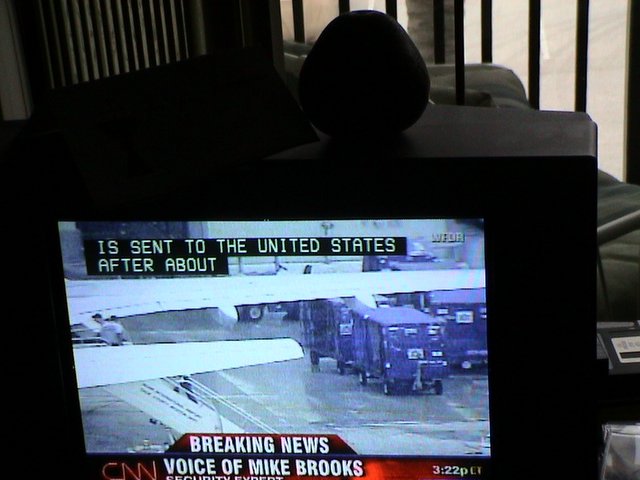
Breaking News: Shots Fired On American Airlines Flight 924 From Medellin While On Tarmac In Miami

 
 Posted by Picasa
CNN provided intense coverage from a Miami affiliate of a 44-year-old American citizen who ran up and down the aisles of AA Flight 924 chasing his wife. Afterwards in the jetway, he shouted that he had a bomb in his carry-on bag and was shot while reaching for something in it, and also because refused to lie on the floor. The passenger is now dead.

Shots fired by US Air Marshal on AA Flight 924 from Medellin while on tarmac in MIA enroute to Orlando. The plane is at Gate B42 now. SWAT Teams are currently circling and possibly boarding the aircraft and signalling the pilot or police aboard. Latest news is that a passenger made a threatening statement and was shot by the Air Marshal and is wounded but not dead.

Update It appears the incident is essentially over. The passenger was shot after saying that he had a bomb while in the "jetway" - the covered passage between the terminal and the jet itself. Officials say he was shot after the passenger said he had a bomb in his carry-on luggage as he was gtting off the plane and appeared to be reaching into the carry-on bag for something.

ERHE Buying Spree

Purchases of ERHE are running 500 percent ahead of sales orders this morning, with more than 516,102 shares purchased and just 96,110 sold as of 11:35:35am EST this morning.

The share price sank to $0.326 before blocks as large as 50K and 100K began trading in earnest around 10:10am EST.

The buying had little effect on price, however, except to move the Ask back to $0.34 and the Bid to $0.335.

Update, 1:07pm EST: 245,000 shares were picked up in the last half hour, perhaps signaling news that we haven't seen yet. Blog traffic is also up dramatically. The Bid and Ask have risen to $0.34 x $0.345. Volume cracked a million, at 1,017,712.

Update, 1:19pm EST: A 90K purchase just hit, and now they're popping like firecrackers at $0.35 in consecutive Buys. We're at $0.345 x $0.35. Volume is 1,187,712.

Update, 3:18pm EST: Volume is 1,569,812 after a 175K buy in 6 chunks ranging from 5K to 60K, the latter at $0.36, the high of the day. The Bid and Ask are 0.345 x $0.355 per E*trade, $0.35 x $0.355 per ADVFN.
Update, 3:38pm EST: Another 50K buy, but the Bid and Ask have fallen to 0.345 x $0.35.

Chrome Energy Is Refinery Bidder With Asian Group

An article in the staid and reliable Guardian of Nigeria this morning reveals that it was Chrome Energy, the Cayman Islands-headquartered owner of 300 million shares of ERHC Energy, that made one of only two timely bids for the Port Harcourt Refining Company, Nigeria's largest refinery, and that the government of rebellious Rivers State has a stake in the bid not revealed in yesterday's ThisDay Online story.

Including the state-owned Rivgas Petroleum and Energy Co. in the consortium led by Chrome may be a stroke of genius, because thorny relations with that state and its activist ethnic communities has led to huge costs for Shell, Chevron and other multinationals who need the state's ports, pipelines and processing facilities to maintain a steady flow of oil abroad.

Also included in the consortium according to the Guardian is an oil services company named Starcrest Energy, which is headquartered at a private residence (with a small swimming pool) in a Plano, TX, suburban tract home. Little is known about that firm.

Essar marketing XEO Raj K. Varma, and also Ndubuisi Nwan, a Rivers State official, both from the the so-called Asian Group of companies bidding with Chrome for the refinery, are quoted at length in the story. By quoting these two so extensively and others not at all, the newspaper may be hinting broadly that Nigeria is strongly leaning towards accepting its bid for the refinery, which is currently operating at 60 percent of capacity. Chrome Energy has done turnaround maintenance (TAM) at the facility for years.

It also suggests the possible emergence and shape of an eventual African giant of the oil industry, a unified and fully integrated company capable of drilling, piping, processing, refining and shipping crude to the oil-hungry markets of Asia, Europe and the United States. At this stage, the Asian Group consortium lacks only a Korean manufacturer of floating oil platforms.

Chrome Energy, as the parent of ERHC, is a substantial player in the five recently-awarded blocks of the Nigeria-Sao Tome and Principe Joint Development Zone and enjoys rights to about a quarter of the estimated 14 billion barrels of oil believed to lie in the Gulf Of Guinea's tranquil waters.

The move by Chrome Energy has spooked many ERHC investors because control of ERHC lies in the hands of Chrome Energy. ERHC Energy chaiman Sir Emeka Offor mformally transferred his personal holdings of 309 million, or about 43 percent, to Chrome Energy, a company he wholly owns and set up last year in the Cayman Islands, where tax and SEC-related reporting requirements are markedly less stringent.

At the same time, it has shown a notable reluctance to support the company in the form of positive publicity, or to inform stockholders about behind-the-scenes dealings that are widely reported in Nigeria.

While there are some long-term holders of small quantities of the stock, none are powerful institutions; most who hold it are speculators who dump it each time it rises towards a dollar. The pattern of benign neglect on the part of company officials has stirred speculation that Offor will abandon ERHC Energy and move forward with the Chrome Energy platform in control of it. The stock (OTCBB symbol: ERHE) has fallen sharply to historic lows as speculative oil stocks like IVAN, FEEC, HDY and TMY - and all well-estabilshed oil stocks - have risen sharply in the past year.

Even as many speculators are preparing for yet another seasonal dump when markets react to signings of Production Sharing Contracts with the Joint Development Authority this month or next (or later), with events moving away from ERHC Energy they may encounter little interest above the $0.40 level.

There are alternate possibilities, such as the wealthier partners in the Asian Group, CNPC and Essar, joining with Addax to buy out Chrome Energy's holdings of ERHC. It is uncertain how ERHC Energy stockholders would be compensated in that circumstance, if at all, and whether any regulatory framework would adequately support stockholder interests.

The most pleasing possibility rests on Offor's reputation as a straightforward businessman who has not heretofore been known to hurt his own investors. In that scenario, he would either sell the Chrome Energy holdings and control of the company outright to the highest bidders, enriching stockholders in the short term, or continue to develop its equity interests in the JDZ and STP EEZ with other partners, slowly raising the share price.

Here is the Guardian article from today's editions:

BPE lists condition for evaluation of Port-Harcourt refinery bids
By Yakubu Lawal

THE Bureau of Public Enterprises (BPE) has said that it had listed the condition for evaluating the technical bids submitted by prospective bidders for the Port-Harcourt refinery.

This development the Enterprise said followed the submission of bids for the sale of the Port Harcourt Refinery which closed last weekend with four consortia affirming their interest to buy the plant.

A statement issued by the Head of Public Communications, Mr. Chigbo Anichiebe, however, said this would be subject to satisfactory evaluation of the above developments. The BPE will proceed with the technical evaluation of these submissions to determine bidders who qualify to have their financial bids opened.

He stated that the technical evaluation would be carried out in accordance with the following broad criteria:

(1) Experience in the ownership, operation and management of a crude oil refining plant;

(2) quality and credibility of the bidder Post Acquisition Plan for the refinery;

(3) demonstrated financial capacity to finance up to US$200 million of capital expenditure by PHRC within the next three years; and

(4) adequate measures for addressing labour and other social considerations.

According to him, at the close of the deadline for submission, only four submissions were received from the following consortia: These are Chrome/Chinese Petroleum Corporation/Essar Oil Consortium, Oando Group, Refinee Petroplus Consortium and Transnational Corporation Consortium.

He stated that the bids were submitted in three offices contemporaneously namely, Director General, BPE, Director, Energy, BPE and Credit Suisse First Boston (CSFB), London (Transaction Advisers for PHRC privatisation) duplicate copy only of its technical bid.

Anichiebe explained while two prospective bidders issued with bid documents entered into an alliance and submitted a joint bid while two other prospective bidders wrote to request for an extension of the bid submission deadline. No response was received from the remaining three prospective bidders.

However, contrary to speculation that some companies who submitted their bids failed to do so within the stipulated time frame, Anichiebe said: "We understand from CSFB, London that one of the bidders who had in fact submitted to BPE, did not meet the deadline for submission of the duplicate copy of the technical bid. Also one of the bidders who met the deadline for submission of the duplicate copy of the technical bid to CSFB, London, did not meet the deadline for submission to the BPE. The BPE is presently evaluating the implication of these developments."

The Guardian gathered that at the close of the bid at the weekend, those companies who submitted their bids include, Essar Oil Limited, Starcrest Energy, Chrome Energy, Rivgas Petroleum and Energy Limited, and the China Petroleum Corporation (CPC) and Bauchi State government.

Others said to have submitted their bid include Oando/Shell Group. Of all the bidders, the Asian Group and the Oando/Shell consortium are said to have met the 5.00pm (Friday) deadline. The two others are said to have delivered their bids to the BPE much later.

The Asian Group is bidding on the strength of its expertise in all sectors of the oil and gas industry as well as an independent producer of power in India.

As an integrated oil and energy company, Essar is said to have competencies in various sectors of the oil industry from exploration, drilling to retailing. It has a 300,000 per barrel ultra-modern refinery, about 500 filling stations, and plans to increase the outlets to 5000 by 2008. The company is also operating in Myannar, (Burma), with a production-sharing contract signed for the operation of one onshore and one offshore bloc.

Mr. Raj K. Varma, the chief executive officer (Marketing Division) of Essar, who led the consortium to submit the bid for his company, which is believed to have competencies in exploration, production, refining and marketing, is using the refinery as a bridgehead to enter into the Nigerian oil and gas industry

"The first step that we have taken here is to bid for the Port Harcourt Refinery. Later, we will certainly go into the upstream and downstream sectors," he said.

He said his group is aware of the problems of the refinery, which he claimed the companies are competent to handle. "Our first priority as a consortium would be to rehabilitate all equipment that are not operating at the moment and ensure the certainty of the plant operating at between 80 and 90 per cent in the immediate future and peaking at 100 per cent or beyond."

The group, he said, does not foresee any difficulties in rehabilitating the refinery, which has hardly operated at 60 per cent capacity since it was built and managed by the Port Harcourt Refinery Company Limited, a subsidiary of the Nigerian National Petroleum Corporation (NNPC). "It is not very difficult, because all you need to do is refurbish the equipment, replace what cannot be repaired, put in money, allocate something like $230 million to be spent in the first couple of years on top of whatever we pay to buy the equity."

He said Essar, which has assets of about $4.4 billion, and has steel, telecommunication, oil and gas, shipping, and energy arms is shopping for land to an Independent Power Plant (IPP).

Varma said beside the availability of capital, the consortium has the technical expertise to operate the refinery. "We have a large number of very experienced people in the refinery, processing and maintenance and projects," he said. "The China Petroleum Corporation (CPC) has a large number of refineries in Taiwan."

Varma said the consortium took into consideration, the operating environment, by including the Rivgas Petroleum and Energy Company, owned by the Rivers State government. The idea is that "given the history of this refinery and the problems with the community, taking on the company owned by the state government will create a conducive operating environment." That synergy was conceived to give the host community a stake in the resources in its area, and also empower the people of the area, through local content packages, which the consortia have consciously conceived.

Mr. Ndubuisi Nwankwo, who is special adviser to the Rivers State governor on Energy and Natural Resources said his state was happy with the consortium, although he would not disclose how much the state is investing in the business. "When we win the bid, the partners will sit down and decide who brings what." He was confident that the bid would succeed. "We are most qualified. We are more experienced in refining business and we have a strong capital base."

BPE said only bidding consortia that score above the minimum technical score of 60 will be eligible to have their financial bids opened. In accordance with BPE procedures, public opening of financial bids will take place at a date, in the immediate future, to be announced shortly.

Tuesday, December 06, 2005

Chrome, ERHC's Parent, In Bid With Taiwan's CPC And India's Essar To Buy Nigeria's Largest Refinery

ThisDay Online's Mike Oduniyi reports in tomorrow's editions that Chrome - whether Chrome Oil Services or Chrome Energy, the largest stockholder in ERHC Energy, is left unstated - is partnered with the Taiwan's Chinese Petroleum Corp. and India's Essar Oil in one of four consortia bidding for ownership of the Port Harcourt petroleum refinery, Nigeria's largest.

Chrome, Essar, and the Chinese partner may be one of the two consortia that make the final evaluation process because of late documents and bids by two of the other consortia.

The bid marks the first time that a long-expected connection between the Chinese and ERHC Energy's chairman has been publically made since the latter went to Taiwan last summer. Chinese Petroleum Corp., with 14,000 employees, is the Republic of China's largest oil company, has 57 producing well in western Taiwan and recovered more than 5 million barrels of crude from fields in Ecuador and Indonesia in 2004. It is currently exploring other blocks in Venezuela and Australia.

But the fact that a major Indian firm has also partnered with us is icing on the cake; Essar already owns a US$2.14 billion refinery in Vadinjar, India, and its shipping arm, which enjoyed a 50 percent rise in profits last year, owns at least one supertanker and was the first Indian company to ship North Sea crude. The company's oil exploration arm is expected to hit oil in the Bombay High and another offshore field at a substantial depth and at onshore sites in Rajasthan and elsewhere, and its technology arm is focused on the oil and gas sector. See its well-produced Website at http://www.essar.com/ for more information, but note this blurb from its shipping division:

In the first six months of this fiscal we have moved 150 million barrels of crude for different oil companies the world over, which is the highest amount of crude moved by any Indian shipping company. And this is primarily because we are able to control the full logistic chain, as is being now sought by oil companies," says Mr. Sanjay Mehta, CEO and Managing Director of the company.

The supply chain solutions provided by the company include shipping, terminal activities, storage, lighterage, ultimate delivery of oil to refineries and taking the products out of the refineries for onward transportation.

"We envisage that in one year from now, oil companies will no longer work with just traditional shipping companies, but with companies which can provide full logistic solutions," Mr. Mehta told Business Line.

Essar Shipping has firmed up long-term contracts involving provision of such supply chain solutions with global oil majors such as Exxon, Chevron and BP. While the company handles shipping and related activities such as lighterage and storage, other operations like terminal activities are outsourced. "This is one reason for consistency in our operating revenues because of the incremental earnings. At every stage we earn money," according to Mr. Mehta.

With the company planning to focus on energy transportation and management further in the coming years, it has opened offices in New York and Beijing. "For example, Exxon Mobil operates seven refineries in the US. Logistic experts from our New York office visit the refineries and study the crude mix - that is from where the crude will be shipped for the whole year. And then we prepare a supply chain proposal, which we totally execute. We have saved Exxon about 15 cents a barrel in transportation cost during the last two years, which is quite significant," he said.

Oduniyi is a veteran oil industry writer who has broken major stories in the recent past. The revelation that Chrome's Emeka Offor has teamed with a Chinese partner to bid for the Port Harcourt Refining Company, a refinery that Chrome Oil Services has long been contracted to maintain, is sure to excite speculation about Chinese participation in the output of the Nigeria-Sao Tome Joint Development Zone, where ERHC Energy has substantial equity in five blocks and Production Sharing Contracts are due to be finalized this Spring or sooner.

It also fulfills a recommendation ERHC On The Move made to ERHC Energy Chairman Sir Emeka Offor last year to buy or build a refinery, and bears out the warning we made to U.S. officials last month that Chinese oil companies will seek hegemony in West Africa and must be successfully challenged all across the value chain - drilling, platforms, pipelines, refineries and shipping. At least on the refinery front, it now appears to be almost too late for other American players to do so in Nigeria, as other refineries in Nigeria are in poor shape and require large investments to restore their productivity.

Should Taiwan's Chinese Petroleum or India's Essar Oil partner with ERHC Energy in the Sao Tome EEZ, where it is expected to gain substantial equity from treaty rights granted in 2003, America's opportunity to find new, rich and long-lived oil reservoirs in West Africa - expected to account to a quarter of U.S. imports within the next 20 years - may largely be lost.

The situation is made only slightly less grave because the Chinese firm is Taiwanese, and both Taiwan and India are American allies. Nonetheless, Taiwan yet must live in the giant aggressive shadow of the mainland People's Republic of China, and India's government has gyrated wildly over the past three decades in its diplomatic relations with the United States, which are currenly near an all-time high. What is Taiwanese today is always in danger of becoming PRC property tomorrow, and a move back to India's controlled economy could shift the diplomatic balance against us again. For the time being, however, especially for ERHC Energy, everything's rosy.

The failure of the U.S. government to bond with ERHC Energy lies primarily with ExxonMobil and Anadarko Petroleum, its rivals in the pitched battle for Block 4 that was ultimately won by ERHC, more than the U.S. government.

Using its connections back home and in Sao Tome, the two companies have pushed delays and probes and problems at the tiny West Nigerian-owned, Houston-based company rather than deal with it as the most promising of the new African players in the Gulf of Guinea, and have used their collective influence to turn the media and politicians against the company.

Here is the article by Oduniyi from Tuesday's ThisDay Online:

Chrome, Oando, Transcorp Jostle for PH Refinery;
BPE releases guidelines

By Mike Oduniyi, 12.06.2005

Submission of bids for the sale of the Port Harcourt Refining Company Limited (PHRC), closed weekend with four consortia meeting the deadline out of the 10 firms that had expressed interest in acquiring controlling stake in the country’s biggest refinery.

The consortia are the Chrome/Chinese Petroleum Corporation/Essar Oil Conso-rtium, the Oando/Shell Group, Transnational Corporation (Transcorp) and Refinee Petroplus Consortium.

The Bureau of Public Enterprises (BPE), the Federal Government agency managing the privatisation of state owned enterprises, yesterday released the guidelines for the conduct of the open bidding for the PRHC.

According to the BPE, the company, which houses two refineries, namely the Old Port Harcourt refinery and the New Port Harcourt refinery, will be sold before the end of this year.

The BPE had issued Final Bid Documents to 10 prospective bidders on November 18, 2005 but only four consortia were able to submit the bid packages at the expiration of the deadline for the submission Friday.

The agency said yesterday that while two of the firms that had expressed interest entered into alliances, two other firms wrote to request for an extension of the deadline, while the three remaining bidders did not respond.

However, of the four consortia that met the deadline, indications are that two may not qualify for the final opening of bids.

According to the Head of Public Communications of the BPE, Mr. Chigbo Anichebe, the agency was briefed by Credit Suisse First Boston (CSFB), London, its Transaction Advisers for the PHRC privatisation, that while one of the bidders did not meet the deadline for submission of the duplicate copy of the technical bid, another one which met the deadline for submission of the duplicate copy of the technical bid to CSFB did not meet the deadline for submission to the BPE.

“The BPE is presently evaluating the implication of these developments. Subject to satisfactory evaluation of the above developments, the BPE will proceed with the technical evaluation of these submissions to determine bidders who qualify to have their financial bids opened,” Anichebe said.

The bids, he added, will be evaluated on the following criteria: Experience in the ownership, operation and management of a crude oil refining plant; Firms must demonstrate financial capacity to finance up to $200 million (N26 billion) of capital expenditure by PHRC within the next three years; Quality and credibility of the bidder’s Post Acquisition Plan (“PAP”) for the refinery, and, Adequate measures for addressing labour and other social considerations.

“Only bidding consortia that score above the minimum technical score of 60 will be eligible to have their financial bids opened,” added Anichebe.

Meanwhile, Mr. Raj K. Varma, Chief Executive Officer (Marketing Division) of Essar, who led the consortium to submit the bid, told THISDAY that his company, which has competences in exploration, production, refining and marketing, is using the refinery as a bridgehead to enter into the Nigerian oil and gas industry.

Varma said that beside the availability of capital, the consortium has the technical expertise to operate the refinery. “We have a large number of very experienced people in the refinery, processing and maintenance and projects,” he said. “The China Petroleum Corporation (CPC) has a large number of refineries in Taiwan.”

Also, speaking to THISDAY on the chances of Transcorp in the bid for the Port Harcourt refineries, the Chairman of Transcorp Technical Committee on Oil and Gas, Mr. Femi Otedola, said that the company was seeking to manage the PHRC with the objective of ensuring that such national assets remain in the control of Nigerians.

“We believe in the process of making sure the general public of this country get the opportunity to participate in the oil and gas business; we also believe that a strategic national asset such as PHRC should be managed and run by efficient hands, with an interest very close to home,” said Otedola.

“As a direct consequence, the resulting benefits will be realised by our shareholders and will subsequently trickle down into the economy, thus benefiting Nigerian citizens as a whole,” he added.

The PRHC, according to BPE data, has an authorised share capital of N5 million, divided into 5 million ordinary shares of N1 each.

Only one of the two refineries in the company is currently in operation, following the closure of the Old refinery while plant capacity utilisation presently stands at 60 percent.

Monday, December 05, 2005

Chevron Sees Bright Prospects In JDZ

An article in the daily Punch of Nigeria this morning may indicate renewed interest in the Nigeria-Sao Tome and Principe Joint Development Zone spurred by the news of Chevron's plans to sink a mile-deep exploratory well in Block 1 in January 2006.

Unlike articles from Reuters, Agence France-Presse, Rigzone and various Nigerian newspapers that concentrated strictly on a Chevron press release, the Punch story by Clara Nwachukwu offers some useful chat about other blocks in the JDZ, although it fails to present accurate information about signature bonuses on other blocks - especially Block 4.

In Blocks 2 and 4, both of which abut Block 1, high bonus fees and complicated partnering arrangements have delayed signing of Joint Operating Agreements with partners and players and Production Sharing Contracts with the Nigerian and Sao Tomean governments.

The bad news is the lowball estimate of possible reserves in the Gulf of Guinea JDZ, which in this article have fallen to "six to 10 billion" barrels of crude compared to estimates from the likes of the Houston Chronicle last February of up to 14 billion barrels.

The good news is that Chevron and a smaller partner, EEL/Afren, feel the chances of hitting oil are 55 to 56 percent.

Here is the article, from this morning's editions:

Chevron begins JDZ exploration in January

Clara Nwachukwu with agency report

United States energy giant, Chevron, has said it plans to commence drilling of its oil wells in the Nigeria/Sao Tome and Principe Joint Development Zone from January, 2006.

Chevron aims, therefore, to set the record as the first of the oil companies given licences to operate in the JDZ to begin exploration activities, estimated to cost it about $60million.

Agence France Presse, quoting a spokesman of the company on Friday, said the oil wells situated in Block 1, which it won in 2003, would begin commercial oil production in the zone by 2010, if significant amount of crude was discovered.

The well has a depth of 1,700metres (5,600feet), which Chevron hopes would be completed within 60 days.

The block carried a signature bonus of $123million and is the first of six blocks in the zone to be jointly awarded by the two countries.

The two countries awarded five other blocks adjoining Block 1 to various consortia in May, but have yet to sign production sharing contracts with them.

Under the treaty signed in 2001, Nigeria will get 60 per cent of all oil and gas revenues from the zone while Sao Tome will receive the balance of 40 per cent.

The first process of acreage allocation in the Nigeria/Sao Tome and Principe JDZ began on August 23, 2003 when the 2003 NDZ Licensing Round opened for nine blocks.

At the expiration of the deadline, 33 bids were received from 20 oil firms, both multinationals and indigenous companies.

Block 1 with surface area of 704 square kilometres, was subsequently awarded to Chevron as the operator with 51 per cent interest and Esso Exploration and Production Niger-Sao Tome (One) Limited (“ESSO”), and Dangote Equity Energy Resources with participating interests of 40 per cent and nine per cent respectively.

But other blocks were not awarded in that round due to lack of technical and commercial competence on the part of the companies.

Thereafter, Blocks 2 to 6 were offered for bids in the 2004 JDZ Licensing Round.

The five blocks formed part of the blocks that were not awarded in the 2003 Licensing Round. Block 1 to 6 have total surface area of 4,568 sq.km or 13.2 per cent of JDZ. Consequently, award of blocks 1 to 6 would leave 86.8 per cent of JDZ for future investors.

During the bid rounds, Block Four attracted bids of up to $175million, while Block Two commanded a top bid of $135million while the three other blocks attracted much more modest offers of between $37million and $45million

It was projected that the signing of Sao Tome and Principe’s first offshore oil contract, will trigger an immediate windfall payment of nearly US $50 million.

The Nigeria/Sao Tome and Principe Joint Development Zone, defined by formal bilateral Treaty, is an area of overlapping maritime boundary claims that is being jointly developed to the benefit of the two countries and add to the proven West African frontier potential.

With Chevron given the right to conduct exploration activities in deepwater JDZ Block 1, the fiscal terms were negotiated as part of the PSC for JDZ Block 1 and will form the basis for future PSC terms in the JDZ.

The JDZ is estimated to hold substantial reserves, possibly as much as six – 10 billion barrels.

The PUNCH, Monday, December 05, 2005

Saturday, December 03, 2005

Sao Tome Attorney-General Accused of Abuse of Power, Engaging in "Western bang-bang" Justice; Tela Non Adds To Report

The official leading the probe of the award of Block 4 in the Nigeria-Sao Tome and Principe Joint Development Zone, Sao Tome Atty. Gen. Arlindo Pereira, has been charged by the nation's Minister of Justice with abuse of power and dispensing "Western bang-bang" justice, the Sao Tome newspaper Vitrina reported Dec. 1.

Update: A new (Dec. 1) report from Tela Non (see underlined material in article below the first) provides additional details.

Pereira's office has been the vehicle for a corruption probe launched by a stand-in for ExxonMobil and Anadarko Petroleum, losers of the bidding war for Block 4 of the Joint Development Zone. That stand-in, R. Dobie Langenkamp, comes from the NELPI organization at Tulsa Law School; NELPI's 100-member advisory board there has 16 lawyers from the two companies, while Noble and ERHC Energy - the winners of Block 4 - are unrepresented.

Langenkamp seemed to be taking over the attorney general's office under sponsorship of the Earth Institute, which is paying his salary. The Earth Institute gets its money from George Soros, who is a key stockholder in Pioneer Natural Resources, which is paired with ERHC Energy in Blocks 2 and 3.

At a press conference launching the probe, when Pereira said there was insufficent evidence for corruption charges, Langenkamp was quoted as saying that the probe had to go ahead to find the evidence. The probe was supposed to have lasted six weeks, but lately there has been little sign of it.

President Fradique de Menezes acknowledged he was one of the people questioned in the probe, but was apparently not too worried about it.

Last Wednesday, the Ministry of Justice accused Pereira of practicing abuse of power that has strained relations between his office and the Ministry.

The Sao Tome Ministry of Justice condemned Pereira, the nation's "Procurador-General," of fomenting divisions between the two central agencies of law enforcment and the courts and doing "constant, continual, deliberate and unsupported violence" to relations between the offices.

The extremely harsh accusations originated in the country's leading newspaper, the Weekly Mail (Correio da Semana), and were made by Justice Minister Elsa Pinto. The article said the Attorney General denied the charges.


Here is the article in the original Portuguese:

GOVERNO E PROCURADOR-GERAL DA REPUBLICA: RELACIONAMENTO AZEDO.

01.12.2005-J.Vitrina-(S. Tomé) Uma crise grave marca actualmente o relacionamento entre as instituições ministério da justiça e a procuradoria-geral da república. Alguns factos que estão na origem desta crise foram denunciados em primeira-mão pelo semanário Correio da Semana, o que levou o procurador-geral da república a fazer um desmentido.

Mas esta terça-feira, a ministra da justiça decidiu denunciar todo um conjunto de situações e acusou Adelino Pereira da prática de abuso de poder, quebra de relações institucionais e de fazer péssima interpretação do papel de fiscalizador que lhe cabe como Procurador-geral da república. A ministra Elsa Pinto diz mesmo acreditar que o poder subiu à cabeça do delegado procurador da república.

Falando em tom particularmente duro, Elsa Pinto adverte que “fiscalizador não significa ditar ordens, fiscalizador não significa imiscuir na acção de outros órgãos de soberania, fiscalizador não significa ser justiceiro a western bang bang”.

“Nós não podemos, a luz do estado do direito democrático ter um justiceiro à western: eu vos prendo em nome da lei”, sublinhou, enfatizando que desde a nomeação de Adelino Pereira que se tem vindo a assistir a uma “constante, continua, deliberada e insustentável violação” do relacionamento institucional entre o procurador geral da republica, o governo e a administração pública no seu todo.

Referiu também que “o governo tem sido surpreendido” com interpretações de recursos em tribunal e muitas vezes o ministério público ao invés de fazer o papel de defensor do estado, coloca-se na posição inversa.

A ministra da justiça realça que existe, de facto, uma “deslealdade funcional e quebra de lealdade institucional insustentável” que já foram levadas a conhecimento da primeira-ministra Maria do Carmo Silveira de quem se espera uma tomada de posição no quadro da lei. M.Barros


Update, 5/12/05, 2:47 EST: Vitrina's chief competitor, Tela Non, has come out with a much fuller report on Sao Tome Justice Minister Elsa Pinto's denunciation of Attorney General Arlindo Pereira.

The Tela Non account, rather cryptically, discussed two "international agreements" and "professional secrets" that are partly at the root of the dispute between these two principal agents of Sao Tomean justice. While we suspect the international treaty in question is the Abuja Declaration and a supporting treaty, we will have to wait for an official source that is more forthcoming to know for sure.

Here is the Tela Non piece:

O PODER NÃO NOS PODE SUBIR A CABEÇA .TEMOS QUE O CONTER AO ESPÍRITO DA LEI

Está instalado o “braço-de-ferro” entre a Ministra da Justiça (na foto) e Assuntos Parlamentares e o Procurador Geral da República. Elsa Pinto não gostou das últimas declarações feitas pelo Procurador Geral a imprensa o que revela a falta de lealdade institucional e uma certa ligeireza como as questões de Estado são tratadas.

O mau relacionamento institucional com o Procurador Geral da República, Adelino Pereira e as declarações públicas proferidas este fim-de-semana pelo procurador obrigou a ministra Elsa Pinto (na foto) a dar uma conferência de imprensa para esclarecer os factos.

“Acho que é mais do que um simples responder as intervenções do procurador geral ou as questões que foram levantadas na Assembleia Nacional. É mais do que isso. Quis alguém em tempo oportuno levantar o véu sobre este assunto não se trata de uma questão de mero corte de relações entre o Procurador Geral e a Ministra da Justiça, subsequentemente, o Governo. Não se trata de um deixar de falar entre o procurador geral e a Ministra ou o Procurador Geral e o Governo. É muito mais profundo do que isto”, justificou Elsa Pinto na sua nota introdutória, para acrescentar que no País “existe uma lei orgânica que rege o funcionamento da Procuradoria Geral do Ministério Público, a lei nº9/91 de 27 de Dezembro”.

Na lei, segundo Elsa Pinto, “estão confinados quer as prerrogativas do Procurador Geral, as competências do Ministério Público quer também a prerrogativas do Ministro da Justiça. A nossa Constituição é clara, é o Governo que propõe a nomeação do Procurador Geral e é o Presidente da República que o nomeia. Não se trata de uma subalternidade, em termos de competência. Mas, eu acho que o que está sobre a mesa é a questão da relação institucional entre o Governo e o Procurador Geral da República, entre o Ministro da Justiça e o Procurador Geral da República".

“Como diz o Procurador e muito bem. Ninguém está acima da lei. Eu acho que a lei aplica-se “erga hominis”, à todos e não há excepção. Significa que este princípio também é aplicável ao próprio Procurador Geral da República. Ninguém está acima da lei”, afirmou Elsa Pinto, recordando as declarações feitas pelo Procurador Adelino Pereira no fim-de-semana a imprensa.

Elsa Pinto foi mais longe ao afirmar que “desde a nomeação do Procurador Geral, digamos que eu entrei para o Governo em 2002; fiz parte dos sucessivos governos, e já naltura, o meu antecessor tinha algum problema de relacionamento com o Procurador Geral. Tudo tem a ver com a acepção ou a concepção do que se faz , do papel fiscalizador do Ministério Público”.

A ministra é de opinião que “existe um mau entendimento daquilo que é o poder fiscalizador. Fiscalizar não significa imiscuir nas acções dos outros órgãos de soberania, fiscalizar significa ser o justiceiro à western, bang-bang! Fiscalizar significa que nos termos desta lei o Ministério Público pode promover aos tribunais, pode propor medidas abdicadas ao Governo e, claro, pode realmente agir no quadro consignado nesta lei”.

Elsa Pinto assegurou que tem vindo a assistir “desde a nomeação do Procurador a violação flagrante, contínua e deliberada desta relação institucional” O Executivo, segundo a titular da pasta da Justiça e Assuntos Parlamentares é muita das vezes surpreendido por interposições de recursos, por acções em tribunal sem prévio conhecimento. O ministro da Justiça não sabe absolutamente nada!” admitiu, acrescentando que “são soluções que possivelmente se fossem aplicada à norma e diz ele que é o fiscalizador devia estar realmente em consonância com a lei, nós podíamos inclusive evitar situações. A lei diz que ele pode solicitar esclarecimento e propor medidas adequadas ao governo para sanar as situações de irregularidades o que nunca aconteceu!”

“É uma faca de dois gumes. O Ministério Público é defensor do Estado, mas muitas das vezes é o revés, é o contrário, e o governo é surpreendido!” sublinhou de modo categórico.

De acordo com as palavras de Elsa pinto, duas questões foram a gota de água que transbordou o vaso: a primeira relacionada com a demolição pela Direcção de Obras Públicas e Urbanismo de um imóvel nas imediações do Largo da Conceição na cidade de S. Tomé o que não aconteceu, porque o director da DOPU tem um superior hierárquico (O Ministro) e não tendo acatado as directrizes do Ministério público foi-lhe movido um processo, e posteriormente julgado por crime de desobediência e absolvido; e a segunda com a carta dirigida pelo Procurador, em termos indecorosos ao ministro da Economia, do domínio do Comércio, Indústria, Turismo, Agricultura e Pescas, Gaudêncio Costa a qual reputou de “muito confidencial”, sem qualquer respeito pela ética e a deontologia por se tratar de um Ministro da República.

Elsa Pinto reputa de mais grave o facto do Procurador Geral impor ao Ministro da República o princípio de sigilo na sua carta(cumpre-nos porém a obrigação de o informar em vez de “vos” que este pedido reveste-se de carácter de confidencial, e como tal implica a existência de segredo profissional).O Procurador teria mesmo advertido ao ministro que a quebra do segredo profissional implicaria a condenação.

Na perspectiva da ministra Elsa Pinto, o Procurador Geral teria baseado em rumores para se dirigir a um Ministro da República para depois pedir algo que não é da sua competência, não fazendo sequer a diferença entre os contratos em que o Ministério Público tem por competência legítima de os acordos internacionais que o estado celebra.” A nossa Constituição é clara nisto e a lei orgânica também. Cabe a Assembleia a fiscalização dos acordos internacionais e não ao Procurador Geral da República” sublinhou.

A governante sãotomense enfatizou por outro lado que São Tomé e Príncipe “precisa de um Procurador Geral e de um Ministério Público activo, porque não só pelos desafios que vamos ter pela frente, enquanto país é necessário que o combate à criminalidade e a corrupção sejam realmente efectivos”, rejeitando categoricamente a figura de um justiceiro à western “eu vos prendo em nome da lei” para a República.

A ministra da Justiça não perdeu o Procurador Geral por este ter faltado a um encontro de trabalho, evocando motivos de força maior, e na circunstância, ter-se feito representar por um “Procurador Geral-Substituto”, figura que no entender da titular não existe na orgânica do Ministério Público.

“Não há relacionamento. Ele é péssimo. Ele viola as regras que estão aqui consignadas na lei nº9/91”concluiu.

Agora, competirá a Chefe do Executivo sãotomese, Maria do Carmo Silveira, tirar as ilações necessárias e agir em conformidade, deixou transparecer Elsa Pinto.


Francisco Lima

Friday, December 02, 2005

Lusa and Reuters Today: Chevron To Drill in "Giant" Block 1 Next Month

A Chevron spokesman told Portugal's Lusa news agency and Reutersthat it will begin drilling on Block 1 next month. An earlier statement from Chevron widely reported on the Web said drilling would begin "before Christmas."

The first exploratory well will take 60 days to drill and cost $60 million, the company said. The well is located in water that is a mile deep (1,700 meteres), Chevron said.

Both reports are probably by the same person, as Reuters journalist Richard Neto is also Lusa stringer in Sao Tome, according to well-versed poster Homeport.

Meanwhile, a report from Afren, which has a small stake in Block 1, says mapping and 2-D surveys of Block 1 show a high chance of a "giant" field in Block 1, which could contain as much as 500 million barrels of oil, the company said. The technical study along with some intelligible text is located at: http://www.afren.com/pdf/AfrenCPR-Block1b.pdf.

Here is the Lusa article:


Sao Tome: Chevron to begin drilling in JDZ Block-1 next month - company official

Sao Tome, Dec. 2 (Lusa) - US oil company Chevron-Texaco will being drilling exploratory wells in Block-1 of the offshore Joint Development Zone (JDZ) shared by Nigeria and Sao Tome and Principe next month, a company spokesman said Friday.

If commercial quantities of crude are discovered, production will begin in 2010, Tim Persons, the company's representative in Sao Tome, told Lusa.

Persons said the first well would be drilled at a depth of 1,700 meters, estimating it would take 60 days at a cost of USD 60 million.

Block-1, which carried a signature bonus of USD 123 million, is the first of six JDZ blocks to have been jointly awarded by Sao Tome and Nigeria.

Five other blocks, adjoining Block-1, were awarded to various consortiums on May 31 but await the signing of production sharing contracts.

Under a bilateral treaty signed in 2001, Abuja and Sao Tome share JDZ revenues in a 60:40 ration in favor of Nigeria.

RCN/SAS.

Lusa


Here is the Reuters story that also moved today on the same topic, with the Chevron source named:

Reuters news.. Chevron to start Sao Tome drilling in January
Fri Dec 2, 2005 7:54 AM ET
By Ricardo Neto


SAO TOME (Reuters) - No. 2 U.S. oil company Chevron (CVX.N: Quote, Profile, Research) will start its first exploration well in January in a joint exploration area between Nigeria and the West African archipelago of Sao Tome and Principe, a company executive said on Friday.

Tim Persons, Chevron's director in Sao Tome, said the deep water well at a depth of 1,700 meters (5,643 feet) should be completed within 60 days at a cost of around $60 million.

"The drilling work will ... start in January," Persons told Reuters in an interview.

In the case of a commercially-viable discovery, oil production would begin in 2010, Persons said.

Of the nine offshore blocks in the joint development zone, Chevron and its larger U.S. rival Exxon Mobil (XOM.N: Quote, Profile, Research) acquired rights to block 1 just over a year ago for a signature bonus of $123 million.

A signature bonus is an up-front payment made to a government for the right to develop an oil block, often in addition to guaranteed investments in the field.

The Gulf of Guinea has become one of the world's exploration hot spots since a series of huge oil finds in the last 20 years.

Signed in February 2001, the joint development deal establishes a 60 percent stake for Nigeria and the remaining 40 percent for Sao Tome.

http://today.reuters.com/

Wednesday, November 30, 2005

Dow Jones: PSC Signings By Christmas, Nigerian Official Source Says; Sao Tome Approval For Block 4 Still Pending, He Says

In news that is sure to bring smiles to most ERHC Energy investors, a Nigerian petroleum official told the Dow Jones Newswire's Vincent Nwanma Wednesday that Production Sharing Contracts for the five blocks offered in the 2004 Licensing Round will be signed before Christmas.

The Nigeria-Sao Tome and Principe Joint Development Authority that oversees the bilaterally-owned Joint Development Zone in the oil-rich Gulf of Guinea had posted two conflicting schedules for the signings before abandoning both when a new contract had to be written to formalize the substitution of Addax Petroleum for Noble Energy as operator in the highly-coveted Block 4 concession originally won by Noble and ERHC.

After Noble ankled the block last month - as revealed exclusively in ERHC On The Move, precipitating a round of public announcements - the JDA then said in a press release that it had approved the substitution of Addax for Noble and provided an earlier date for PSC signings than a previous press release had supplied.

With both PSC schedules and the Addax announcement on its site, the JDA was embarrassed when it was informed by the Joint Ministerial Council composed of Nigerian and Sao Tomean officials that it alone had the power to approve the siubstitution, albeit on the JDA's recommendation.

It promptly did so, according to only a single article by veteran oil writer Mike Oduniyi in the leading ThisDay Online, but until now the issue of the PSC signings had remained very much up in the air.

But, as we suspected, the Oduniyi article was wrong, at least according to the Nwanma report.

In fact, according to the Dow Jones piece, Sao Tome officials have yet to sign off on the substitution, and they told Nwanma "[W]e need certain clearance from the Sao Tomean end."

Getting clearance from the Sao Tome side is usually far more painful and divisive than pulling teeth, and ordinarily leads to long delays in any contemplated project. With presidential elections scheduled for this Spring in Sao Tome, an island nation of less than 200,000 people, and the opposition power in party in the country's Parliament, the PSC approval by the JMC could still be a protracted affair.

The Nwanma article also has an error. It says, "The JDA made the latest block awards last May, with blocks 2 to 6 being offered to a different consortium made up of local and international oil companies." Actually, the other four blocks were offered to different "consortia," the plural of consortium, and each block has an ERHC Energy equity interest of between 15 and 25 percent.

The article should nonetheless improve the share price of ERHC Energy (OTC symbol: ERHE) substantially from today's $0.34 close, as PSCs could well be signed ratifying ERHC's substantial equity in four of the other blocks in the 2004 Round.

Here is the Dow Jones piece:


Nigeria, Sao Tome Oil Pacts Seen Before Christmas
by Vincent Nwanma
Wed, Nov. 30, 2005 16:40 GMT


LAGOS - Production sharing contracts and joint operating agreements in the oil blocks located in the Nigerian-Sao Tome Joint Development Zone will be signed before Christmas, a Nigerian government source told Dow Jones Newswires Wednesday.

The source also said that the Joint Development Authority, which manages resources in the maritime boundary shared between the two countries, has approved "in principle" Swiss energy company Addax Petroleum's role as operator of block 4 in the zone.

"The agreements will be signed sometime in December, possibly before Christmas. We are hoping so," the source said.

Addax, which already has operations in Nigeria, replaced Houston-based Noble Energy Inc. (NBL) after it withdrew this year from a consortium led by ERHC Energy Inc. (ERHE).

"Addax is almost there," the source said. "We have given an approval in principle, but we need certain clearance from the Sao Tomean end."

The JDA made the latest block awards last May, with blocks 2 to 6 being offered to a different consortium made up of local and international oil companies.

Since then, negotiations have been made on joint operating agreements among the consortia members.

The groups have also been negotiating with the JDA on the terms for the production sharing contract, under which the blocks will be operated.

All the agreements are subject to approval by the Joint Ministerial Council, the highest ruling organ of the JDZ, made up of ministers from the two countries.