The absent 10-Q that was supposed to be filed last week, and then filed within five calendar days ending Wednesday, is provoking an enormous amount of speculation on the message boards devoted to ERHC Energy. Here are some conspiracy theories that might apply:
Conspiracy Theory No. 1: The expenses related to winning the JDZ equity in Blocks 2, 3 and 4 were improperly documented, or not documented at all, and our new high-profile auditors, Malone & Bailey of Houston, will not allow them. The expenses were so high, though - like the $300,000 for travel declared a few years ago - that the absence of documentation could not be overlooked. In Africa, though, record-keeping is notoriously sloppy, and a lot of transactions are accomplished in cash on the African equivalent of a handshake. When expenses start to mount up into the million-dollar range, company officials don't want to have to pay them our of their own pocket when auditors won't approve them, so they stand still and fight about it for weeks until one side or the other gives in.
Probability rating of this conspracy being true: 95%
Conspiracy Theory No. 2: The service of a search warrant has resulted in many documents that are vital to the 10-Q being removed by the U.S. Marshal's office for inspection by Dept. of Justice lawyers and the FBI. Meanwhile, the company is in a holding pattern, trying to pacify investors as it demands copies of the seized material in order to make the filing.
Probability rating of this conspracy being true: 60%
Conspiracy Theory No. 3: It turns out, after all, that company officials are trying to keep the price down so that they can mount a substantial buy-back of shares, so that when the coil is tightened to the nth degree by the delay they can release their 10-Q and press release showing them debt-free with $45 million in the bank, so the profits on the newly acquired 2,000,000 shares as they soar to $1.10 or more will be close to $1,000,000 in a single day.
Probability rating of this conspracy being true: 25%
Please share your own conspiracy theories with us amreporter@aol.com.
Friday, May 19, 2006


Thursday, May 18, 2006
Hello Frank, So Long Jane
Here's the latest on the 10-Q from a respected source of mine, a geologist who knows what's up:
Meanwhile, the Washington Post Website headlines the opening of a House Ethics Committee hearingon three Congressmen including Rep. William Jefferson, the Louisiana Democrat whose bribery charges led to an indictment last week.
Investigative reporters looking into that case have contacted ERHC On The Move in recent months for information about the man who may be America's largest shareholder of ERHC Energy, oilman Phil Nugent of Houston. His accountant, Norma Reynolds, is moderator of the ERHC Energy board on Investor's Hub.
Update, 3:15pm ET, 5/19/06: Here is a story by one of those investigative reports that was just published today:
I just called the company and was told by a very pleasant receptionist at the Houston office (she was hired 2 days ago), that she has been told that the filing is to be out tomorrow. Also, I was told that Jane was let go because of numerous complaints about her telephone communications demeanor. I was told that Frank and Walter would be there all day working...
Meanwhile, the Washington Post Website headlines the opening of a House Ethics Committee hearingon three Congressmen including Rep. William Jefferson, the Louisiana Democrat whose bribery charges led to an indictment last week.
Investigative reporters looking into that case have contacted ERHC On The Move in recent months for information about the man who may be America's largest shareholder of ERHC Energy, oilman Phil Nugent of Houston. His accountant, Norma Reynolds, is moderator of the ERHC Energy board on Investor's Hub.
Update, 3:15pm ET, 5/19/06: Here is a story by one of those investigative reports that was just published today:
House probe of Jefferson unlikely to move swiftly...
Ethics committee usually waits for legal process to play out first
Friday, May 19, 2006
By Bruce Alpert
Washington bureau
WASHINGTON -- If precedent prevails, the House ethics committee investigations into bribery allegations announced this week against Reps. William Jefferson and Bob Ney will be delayed until the federal criminal probes of the two congressmen are completed.
But experts on congressional ethics also say that even if Jefferson, an eight-term New Orleans Democrat, and Ney, a six-term Ohio Republican, are ultimately cleared of criminal wrongdoing, they still could face serious sanctions from the House.
"There is a contrast between behavior that is unethical and behavior that is illegal," said Norman Ornstein, a resident scholar at the conservative American Enterprise Institute and an expert on Congress.
The ethics committee, formally known as the House Committee on Standards of Official Conduct, broke a 16-month partisan impasse Wednesday night by announcing four actions, including the separate probes of Jefferson and Ney. The panel gave no timeline for the investigations, and experts on congressional ethics procedures don't expect quick action.
"I wouldn't anticipate a lot of activity immediately because the committee generally awaits the outcome of a federal criminal case before taking any action," said Stan Brand, chief counsel to the House of Representatives from 1976 to 1983.
Susan Tolchin, a public policy professor and co-author of the book "Glass Houses: Congressional Ethics and the Politics of Venom," agreed, although she said the pressure on Congress to address ethics complaints is now so intense that the panel might at least begin preliminary inquiries before the Justice Department probes run their course.
But it is extremely unlikely that the panel would make any formal recommendations until the legal process plays out, she said.
Jefferson vows innocence
Jefferson, who has proclaimed his innocence and said he would not resign his seat in Congress or plead guilty to a crime he says he didn't commit, is continuing his congressional activities despite the criminal probe and ethics committee review. On Thursday he criticized a Republican budget and spoke on the House floor about the federal government's plans to cut off temporary housing assistance to hurricane evacuees on May 31.
In their announcement Wednesday, ethics committee Chairman Doc Hastings, R-Wash., and the panel's top Democrat, Howard Berman of California, said a four-member investigative subcommittee will determine whether Jefferson violated the House's Code of Official Conduct or any law or regulation. They said the investigation would concentrate on whether Jefferson or his relatives received cash, stock shares, a share of future profits, employment or travel benefits to advance a telecommunications deal in Africa.
Hastings and Berman said the committee probe will concentrate on Jefferson's relationship with Brett Pfeffer, a former aide to the congressman, and Vernon Jackson, CEO of iGate Inc., both of whom have pleaded guilty to bribery in what the government says was a scheme to get Jefferson's help in landing telecommunications contracts for iGate. The ethics committee leaders said the panel also would examine Jefferson's connections to Lori Mody, a Virginia multimillionaire who invested in iGate's African projects but later soured on the deal and agreed to record conversations with the congressman, according to court documents.
Jefferson has not been charged with a crime and has said he never asked for anything to perform his official congressional duties. It appears he is building a possible defense that the business ventures were private matters outside his official duties as a congressman. That, however, could raise issues related to House rules prohibiting members of Congress from receiving outside income or gifts.
Tolchin said that even if Jefferson's argument prevails in court, the ethics committee still could find his behavior violated the House's conduct code and recommend some kind of reprimand.
Range of penalties
The panel can recommend anything from a verbal reprimand for unethical conduct to fines or expulsion. In 1997, then-House Speaker Newt Gingrich, R-Ga., was hit with a $300,000 fine, and after Rep. James Traficant, D-Ohio, was convicted of bribery and racketeering in 2002, the ethics panel recommended his expulsion and the full House concurred.
Groups that had been asking the ethics committee to investigate Jefferson and Ney, the Ohio congressman accused of doing favors for convicted lobbyist Jack Abramoff in return for travel and other gifts, had mixed reactions to Wednesday's announcement.
"It seems they awakened from their 16-month sleep to find that some of their members are being investigated and that it's about time for them to do a little bit of this themselves," said Massie Ritsch, spokesman for the Center for Responsive Politics.
But Melanie Sloan, executive director of Citizens for Responsibility and Ethics in Washington, said it is likely the panel will do nothing, following the rationale that it would be unwise to interfere with a federal criminal probe. "I suspect it will amount to nothing, but at least after two years of doing nothing, they can announce that they are finally doing something," Sloan said.
To oversee the investigation, Hastings and Berman named Rep. Melissa Hart, R-Pa., and Rep. Stephanie Tubbs Jones, D-Ohio. Hart, now in her third term, sponsored the Unborn Victims of Violence Act, which declares that any federal crime of violence against a pregnant woman may be charged as two separate crimes. Tubbs Jones, now in her fourth term, serves with Jefferson on the Congressional Black Caucus and the House Ways and Means Committee.
Bruce Alpert can be reached at bruce.alpert@newhouse.com or (202) 383-7861.
An Unwelcome E-Ticket Ride
Signaling yet another unwanted "buying opportunity," ERHC Energy shares will see their symbol change from ERHE to ERHEE to indicate the company has failed to file its quarterly report on time.
After 30 days, the company can be delisted from the Over The Counter and Pink Sheets.
One consequence is that brokerages like E*Trade show no information beyond yesterday's closing price for ERHE even on Level II platforms like my Power E*Trade, but that is easily fixed by using the symbol ERHEE. (ADVFN, which is only $5.99 a month, also shows every trade in real time for ERHEE.)
Update, 3:25pm ET: With volume still low at 625,871 a three-cent gap has developed. The Bid stands at $0.58 and the Ask at $0.61.
The extra "E" can be removed in as little as one day after filing occurs.
Update, 12:53pm ET: Volume is about 550,000, and Bid and Ask are $0.58 x $0.60, with last two trades being Buys at $0.60. The last was the 111th trade.
Update, 11:43am ET: Volume is about 450,000 and the current price is $0.60 x $0.61, and small Buys and Sells continue to move the Bid and Ask in both directions. The last price was $0.60.
Update, 10:41am ET: ADVFN shows relatively light trading with ERHE up $0.01 at $0.635 on 344,000 shares of volume at 10:41am ET. There was an opening surge to $0.64, until now most of the trading day the Buys and Sells have been evenly balanced.
Our speculation is that the new auditors, Malone & Bailey, have had difficulty resolving issues concerning corporate governance that would allow it to certify the company as in compliance with new requirements created by certain provisions of the Sarbanes-Oxley Act regarding audit functions and the independence of directors, particularly when it comes to recent expenses related to the company's hard-won equity in the Nigeria-Sao Tome and Principe Joint Development Zone.
Inadequate documentation for those expenses would ultimately create a standoff between auditors and company officials that - unless one side backs down - could ultimately lead to a parting of ways with our new auditors.
After 30 days, the company can be delisted from the Over The Counter and Pink Sheets.
One consequence is that brokerages like E*Trade show no information beyond yesterday's closing price for ERHE even on Level II platforms like my Power E*Trade, but that is easily fixed by using the symbol ERHEE. (ADVFN, which is only $5.99 a month, also shows every trade in real time for ERHEE.)
Update, 3:25pm ET: With volume still low at 625,871 a three-cent gap has developed. The Bid stands at $0.58 and the Ask at $0.61.
The extra "E" can be removed in as little as one day after filing occurs.
Update, 12:53pm ET: Volume is about 550,000, and Bid and Ask are $0.58 x $0.60, with last two trades being Buys at $0.60. The last was the 111th trade.
Update, 11:43am ET: Volume is about 450,000 and the current price is $0.60 x $0.61, and small Buys and Sells continue to move the Bid and Ask in both directions. The last price was $0.60.
Update, 10:41am ET: ADVFN shows relatively light trading with ERHE up $0.01 at $0.635 on 344,000 shares of volume at 10:41am ET. There was an opening surge to $0.64, until now most of the trading day the Buys and Sells have been evenly balanced.
Our speculation is that the new auditors, Malone & Bailey, have had difficulty resolving issues concerning corporate governance that would allow it to certify the company as in compliance with new requirements created by certain provisions of the Sarbanes-Oxley Act regarding audit functions and the independence of directors, particularly when it comes to recent expenses related to the company's hard-won equity in the Nigeria-Sao Tome and Principe Joint Development Zone.
Inadequate documentation for those expenses would ultimately create a standoff between auditors and company officials that - unless one side backs down - could ultimately lead to a parting of ways with our new auditors.
Wednesday, May 17, 2006
Tuesday, May 16, 2006
Big Moves: ERHE Climbs As Much as $0.15 in Pre-10Q Trading; "Everything Is For Sale,' Brandhuber Says; CNBC Profile Coming In June
Although it's fallen back to $0.585 five minutes from the bell, just an hour ago ERHC Energy shares were trading at $0.71 after climbing $0.15, or more than 26%, during the day.
The trading has been spurred by the imminent filing of an SEC 10Q that will show the company being nearly debt-free and with $45.5 million in revenues last month against what should be a negligible amount - $1 million to $2 million - of expenses.
The average daily volume mark has still not been reached as of this writing at 3:32pm ET, which means that retail buying should spike again tomorrow when the new numbers are announced. Volume at 3:40pm ET is 2,607.721.
There has also been a flurry of news via email from ERHC CEO Walter Brandhuber to several different posters. The key one was a brief response to one poster who asked about the possibility of ERHC Energy chairman Sir Emeka Offor selling the company, to which Brandhuber replied, in effect, "Everything is for sale at the right price," adding that the current share price is far too low to consider any sale right now.
The new CEO also said that a CNBC profile of the company will appear in the coming months.
The trading has been spurred by the imminent filing of an SEC 10Q that will show the company being nearly debt-free and with $45.5 million in revenues last month against what should be a negligible amount - $1 million to $2 million - of expenses.
The average daily volume mark has still not been reached as of this writing at 3:32pm ET, which means that retail buying should spike again tomorrow when the new numbers are announced. Volume at 3:40pm ET is 2,607.721.
There has also been a flurry of news via email from ERHC CEO Walter Brandhuber to several different posters. The key one was a brief response to one poster who asked about the possibility of ERHC Energy chairman Sir Emeka Offor selling the company, to which Brandhuber replied, in effect, "Everything is for sale at the right price," adding that the current share price is far too low to consider any sale right now.
The new CEO also said that a CNBC profile of the company will appear in the coming months.
Exxon Strikes Oil In Nigerian Deepwater Well
ExxonMobil said today that is struck 300 net pay feet of oil in a 16,000-foot well in Block OML216.
The well is about 60 miles from ERHC Energy's equity in the Nigeria-Sao Tome and Principe Joint Development Zone, where the water depth is about thousands of feet shallower.
Here is the Dow Jones report:
The well is about 60 miles from ERHC Energy's equity in the Nigeria-Sao Tome and Principe Joint Development Zone, where the water depth is about thousands of feet shallower.
Here is the Dow Jones report:
Exxon Mobil Corp. (XOM) drilled an oil discovery well 70 miles offshore Nigeria to a depth of 16,831 feet and encountered more than 300 net feet of oil.
The project is called the Uge-1 discovery well, and is the first discovery on oil prospecting license 214, in which Exxon has a 20% working interest.
Studies are underway to evaluate the well.
Other working-interest owners are Chevron Corp. (CVX) at 20%, ConocoPhillips (COP) at 20%, Occidental Petroleum Corp. (OXY) at 20%, Nigerian Petroleum Development Co. at 15% and Sasol Ltd. (SSL) at 5%.
Nigerian National Petroleum Corp. is the concessionaire.
-John Seward; 201-938-5400; AskNewswires@dowjones.com
10Q At End Of The Day, ERHC Says
In a phone call to ERHC Energy, ERHC On The Move was told that the company's late 10Q may be filed at the end of the day.
"We are hoping to file it at the end of the day, sir," a Nigerian man who answered the phone at the company's headquarters in Houston said at 10:15am ET this morning.
"We are hoping to file it at the end of the day, sir," a Nigerian man who answered the phone at the company's headquarters in Houston said at 10:15am ET this morning.
Monday, May 15, 2006
10Q To Be Filed Monday, Poster Says, But No Such Luck - Yet
Poster Mark St. Amour of the I-Hub message boards said Monday that in a phone call to ERHC Energy headquarters in Houston he was assured by someone named Franklin who answered the phone there that the company's briefly-delayed 10Q filing with the SEC will be filed today.
But by 9:21am ET Tuesday, the filing was still not available on the SEC's Website.
Franklin is probably one of the members of the Board of Directors who is a CPA:
Here is Mark's post:
Mwanwhile, indications are that the $45.5 million payment to ERHC Energy from Sinopec and Addax Petroleum will be included in the current quarter's filing, an event that could lift ERHC's share price above its dismal finish at $0.56 today. Volume was 5,616,131 shares and our market cap has fallen to $398 million.
But by 9:21am ET Tuesday, the filing was still not available on the SEC's Website.
Franklin is probably one of the members of the Board of Directors who is a CPA:
Mr. Franklin Ihekwoaba was appointed the Vice President (Finance) of the Company, in which capacity he becomes the chief financial and principal accounting officer as well as the treasurer of the Company.
Here is Mark's post:
Posted by: markgovols
In reply to: None Date:5/15/2006 4:43:00 PM
Post #of 52351
I just called ERHE offices in Houston. 10Q will be out today. Also, I asked if Mr. Brandhuber will be addressing shareholders concerns over the downturn in sp. He said that yes Mr. Brandhuber will be releasing something in the very short term. Call ERHE to verify.
Take my posts for what they are worth. Better yet do your due dilligence. Long and Strong ERHE.
Mwanwhile, indications are that the $45.5 million payment to ERHC Energy from Sinopec and Addax Petroleum will be included in the current quarter's filing, an event that could lift ERHC's share price above its dismal finish at $0.56 today. Volume was 5,616,131 shares and our market cap has fallen to $398 million.
5,000 Guardsmen To Mexican Border, CNN Says
CNN's Pentagon correspondent said minutes ago that the news agency has learned President George W. Bush will deploy some 5,000 National Guard troops to the Mexican border of the United States to support Border Patrol efforts against illegal immigration.
Earlier, reports from several news agencies indicated thwet troops will not be involved in arresting, detaining, transporting or housing illegals captured under the U.S. Border Patrol's interdiction effort, which resulted in more than 250,000 arrests last year.
It remains unclear whether Mexico will also send troops to the border to support its citizens as they attempt to cross the frontier. In a 30-minute phone call last night, President Bush and Mexican President Vicente Fox discussed the Presdent's plan to deploy the National Guard, and President Fox reportedly expressed his concern about it.
California's Republican Gov. Arnold Schwarzenegger has also asked the President not to deply the troops, and Judiciary Committee Chairman Sen. Arlen Specter and Nebraska Republican Sen. Chuck Hagel and other have also expressed reservations about the plan due to what they say is an overstretched National Guard. Meanwhile, the President's approval rating has fallen below 30 percent for the first time in his presidency, but mnay White House insiders expect his speech tonight will lend a strong boost to the falling approval numbers.
The President speaks to the nation at 8pm ET tonight, and has asked for time from all three networks. It will be carried live in Oprah's time slot on NBC and also on CNN, Fox News and other stations. Commentator Lou Dobbs, who has singelhandedly turned the issue into a national emergency, also plans a special report on CNN at 8:30pm ET.
Earlier, reports from several news agencies indicated thwet troops will not be involved in arresting, detaining, transporting or housing illegals captured under the U.S. Border Patrol's interdiction effort, which resulted in more than 250,000 arrests last year.
It remains unclear whether Mexico will also send troops to the border to support its citizens as they attempt to cross the frontier. In a 30-minute phone call last night, President Bush and Mexican President Vicente Fox discussed the Presdent's plan to deploy the National Guard, and President Fox reportedly expressed his concern about it.
California's Republican Gov. Arnold Schwarzenegger has also asked the President not to deply the troops, and Judiciary Committee Chairman Sen. Arlen Specter and Nebraska Republican Sen. Chuck Hagel and other have also expressed reservations about the plan due to what they say is an overstretched National Guard. Meanwhile, the President's approval rating has fallen below 30 percent for the first time in his presidency, but mnay White House insiders expect his speech tonight will lend a strong boost to the falling approval numbers.
The President speaks to the nation at 8pm ET tonight, and has asked for time from all three networks. It will be carried live in Oprah's time slot on NBC and also on CNN, Fox News and other stations. Commentator Lou Dobbs, who has singelhandedly turned the issue into a national emergency, also plans a special report on CNN at 8:30pm ET.
Niger Delta In Chaos, TIME Says
The nation's leading newsweekly, TIME Magazine, has produced a searing examination of the chaos in the Niger Delta that is available on its Website today.
The magazine says "The latest attacks appear to have been driven more by frustration and an ideology of armed resistance than by thoughts of criminal gain, - a broad hint, perhaps, that civil war is already underway in a nation which barely survived the Biafran civil war that ended in the early 1990's.
Again, since ERHC Energy's equity in the Nigeria-Sao Tome and Principe Joint Development Zone Blocks 2, 3 and 4 is 150 miles from shore, the threats to oil resources in the Niger Delta will worry investors in majors like Shell, Exxon, Total, Final and others more than ERHC.
Here is the TIME story:
The magazine says "The latest attacks appear to have been driven more by frustration and an ideology of armed resistance than by thoughts of criminal gain, - a broad hint, perhaps, that civil war is already underway in a nation which barely survived the Biafran civil war that ended in the early 1990's.
Again, since ERHC Energy's equity in the Nigeria-Sao Tome and Principe Joint Development Zone Blocks 2, 3 and 4 is 150 miles from shore, the threats to oil resources in the Niger Delta will worry investors in majors like Shell, Exxon, Total, Final and others more than ERHC.
Here is the TIME story:
Nigeria's Deadly Days
The country's poverty-stricken, oil-rich south is accustomed to vandalism and pipeline explosions, but a new threat is raising the stakes. Inside the Delta's insurgency
BY SIMON ROBINSON / OPOROZA
Teeming with bird and marine life, giant ferns and towering mangrove plants whose roots straddle land and water like the legs of lumbering animals, the creeks and swamps of the Niger Delta lie over one of the biggest reserves of oil on the planet: 34 billion bbl. of black gold. The region, a watery maze flung across 50,000 sq km in southern Nigeria, is also home to some of Africa's poorest people, and some of its worst environmental destruction. There are villages without power, water, health clinics or schools; pipelines that scar the earth; oil slicks that shimmer on rivers; flares that blaze bright and loud, burning off the gas that gushes to the surface along with the sweet crude. So poor are most who live in the Delta that some are prepared to risk their lives for a bucketful of fuel. Last week, more than 150 people died when an oil pipeline on the outskirts of Nigeria's biggest city, Lagos, west of the Delta, exploded in a massive fireball. The inferno left dozens of bodies charred beyond recognition. Police say that the explosion was most likely caused by vandalism. The pipeline, which ran under a beach, had been uncovered. Small holes had been drilled in it through which thieves could tap off fuel. The leaking pipeline had attracted local villagers who were filling containers when it blew. Nigeria's Red Cross said that the explosion ignited hundreds of cans full of fuel.
Yet incidents like last week's tragedy are not the greatest danger to Nigeria's oil industry. Nigerians have long vandalized pipelines, and some of the operations are organized and professional. In the Delta, gangs of bandits have prowled the brackish swamps for years, stealing oil, harassing oil workers and making millions of dollars. But over the past few months an even deadlier threat has emerged. Frustrated that they remain poor after decades of oil production, locals have begun attacking foreign oil companies, their workers and the Nigerian soldiers who protect them — not, as in the past, for money, but as part of an armed campaign. Unless there is change, they say, there will be war. The government and oil companies "don't listen to words," Delta militia member Richard, 27, told Time three weeks ago, the dull roar of a gas flare in the background. "So perhaps they will understand the language of the gun."
The nascent insurgency has made Nigeria's oil fields among the most dangerous in the world — and helped push global oil prices past $72 bbl. Nigeria was meant to be part of the solution to the insatiable demands for more oil from the U.S. and fast-growing China and India. When the country returned to civilian rule under President Olusegun Obasanjo in 1999, it was pumping around 1.8 million bbl. a day. Daily capacity had expanded to 2.5 million bbl. before the recent attacks; Nigeria is now the sixth biggest oil exporter in the world. Western oil companies, eager for a supply from outside the Middle East, want to increase production from Africa.
On a visit to Nigeria three weeks ago, Chinese President Hu Jintao signed deals to increase Chinese exploration and production. But Nigeria's role as a stable producer has taken a hammering of late. Militant attacks have cut production by 20%, hitting companies such as Royal Dutch Shell, and costing the oil majors and Nigeria hundreds of millions of dollars. "There used to be clashes and other problems, but in the past five or six months things have gotten much more serious," says Manouchehr Takin, senior analyst at the Centre for Global Energy Studies, a London-based consultancy. While it's impossible to work out exactly how much that contributes to rising oil prices compared to the crisis over Iran and increasing demand, Takin says production losses in the Delta are "a major factor" in the high price of gas.
The militants' campaign kicked off on Jan. 11 when three speedboats packed with gun-toting men attacked a Nigerian navy boat and a vessel leased by Shell. No one was killed. But the attackers, who said they were part of a new group called the Movement for the Emancipation of the Niger Delta (mend), kidnapped four foreign contractors. Since then the group, which numbers just a few hundred people, according to a local human-rights campaigner and militant members, has kidnapped at least eight more foreign oil workers and attacked several oil installations, killing some 14 Nigerian soldiers posted to guard them. In the past month, militants have also exploded two car bombs as "warnings" of coming chaos. When I set off with three guides in a cigar-shaped fiberglass boat into the swamps last month, a Nigerian naval officer aboard a warship in the port city of Warri warned me not to go on. "Even we don't go there," he said, motioning along the Warri River. Then he slowly drew a finger across his throat.
Downriver, it's easy to see the cause of this deadly hostility. Since the 1950s, when oil was first found in recoverable quantities, the Delta and the waters off Nigeria's coast in the Gulf of Guinea have made the country and oil majors such as Chevron, Agip, ExxonMobil and Shell hundreds of billions of dollars. Nigeria currently earns more than $3 billion a month from oil — which accounts for some 95% of its export earnings and 40% of its gdp. But the vast majority of the people of the Delta still live in severe and visible poverty.
One of the first activists to speak out against this imbalance was businessman, TV writer and activist Ken Saro-Wiwa, from the Ogoni region, east of Nigeria's oil capital Port Harcourt. Saro-Wiwa preached nonviolence, but Nigeria's then military government charged him with having "counseled and procured" the murder of four Ogoni elders, and in 1995 hanged him, to international condemnation. Despite the return to democracy and government promises to improve the lives of Delta dwellers, little has changed. Today in Oporoza — the traditional center of the Gbaramatu kingdom in whose backwaters, locals say, mend has its bases — villagers gather in a meeting hall and list their grievances. "Poverty is the major problem we are facing here," says Odiki Miebi, a local chief.
True, some of the houses in the village are built of brick and concrete — much more substantial dwellings than the flimsy reed huts that are home to many people in the region. And there is a school, though it has been seriously vandalized, its rooms emptied of furniture donated by Shell. But the village, about 90 minutes from Warri by fast speedboat, is hardly thriving. A water tank installed about a decade ago doesn't work, forcing people to scoop their water from a muddy hole. Worst of all, complains Macaulay Elekute, another elder, there are no local jobs.
Violence in the Delta is nothing new. Tribal conflict has plagued the region for years. Well-armed and organized gangs have been present almost as long as the oil companies, making tens of millions of dollars in "bunkering" operations in which oil is illegally siphoned off (and causing, oil companies have long maintained, most of the local environmental damage as a result). The gangsters have also extorted money by kidnapping oil workers and supplying "security" services in exchange for not attacking installations. In some ways, the situation has been exacerbated since Nigeria's return to civilian rule. According to local lawyers and international human-rights groups such as Human Rights Watch and the London-based Stakeholder Democracy Network, ruling-party politicians have armed local youths — many of them gang members — to ensure that votes go their way. Weapons flooded the region before the 2003 poll, which in many parts of the Delta was less an election than an armed contest. Commonwealth observers found that in the Rivers state and other areas there was "serious violence, intimidation and vote rigging." Mujahid Dokubo-Asari, one of the youth leaders armed by politicians, later turned on Nigeria's security forces and engaged them in gun battles in the streets of Port Harcourt. After Dokubo-Asari called for the breakup of Nigeria last year he was arrested for treason — a charge he denies. Some of his followers are also mend members, according to activists in Port Harcourt and Onengiya Erekosima, spokesman for the political wing of Dokubo-Asari's organization.
The latest wave of attacks, though, is different. The government dismisses mend and similar groups as the same criminal gangs responsible for bunkering and past attacks — and there is undoubtedly some crossover of membership. The region is awash with unemployed men; weapons are easy to find, either left over from the 2003 election or smuggled in by boat from neighboring countries. But the latest attacks appear to have been driven more by frustration and an ideology of armed resistance than by thoughts of criminal gain. While it is "very difficult to draw a line between the criminals and the so-called liberators," according to Anyakwee Nsirimovu, a human-rights lawyer in Port Harcourt, "You do now have groups that articulate certain policies and ideas and principles." Those principles — the oil belongs to us; give us development and compensation or get out — have been cemented by the Nigerian government's handling of the crisis. Dokubo-Asari was little known when he began, say activists in Port Harcourt. But when he turned on the government he became a self-styled liberation leader. By jailing him, the government risks making him the martyr he says he is. mend has demanded his release.
A new ideological coloring to the attacks has been backed by increasingly sophisticated tactics. A car bomb just over two weeks ago, at an oil-truck stop in Warri, was activated by a cell phone and came just days after China's Hu met with Nigeria's leaders. The bomb was "the final warning" before fresh attacks on oil workers, storage facilities, bridges, offices and other "soft, oil-industry targets," a mend official wrote in an e-mail to news organizations. But it was also, the e-mail said, a message to "the Chinese government and its oil companies to steer well clear of the Niger Delta. The Chinese government by investing in stolen crude places its citizens in our line of fire."
Western companies have grown used to working with the threat of attack. But the dangers are increasing. U.S. oil executive Ricky Wiginton, 51, was shot dead in Port Harcourt by assailants riding a motorbike as he drove to work at drilling-equipment maker Baker Hughes last week, and a day later three oil workers with Italian oil contractor Saipem were kidnapped in the same city but later released. mend says it was not responsible for either act, but whoever is doing the killing has spooked the oil companies. Shell, which is by the far the largest operator in Nigeria, has been forced to evacuate staff and scale back operations in the past few months. Time asked representatives of a number of oil companies to comment for this story, but all declined interviews. In an e-mailed statement, a Chevron spokesman said, "We take the security of our people and facilities seriously, and for obvious reasons cannot discuss the measures we implement to mitigate these risks." A Shell spokeswoman pointed to the company's 2004 report entitled People and the Environment, which details the steps the company is taking to clean up environmental damage, train local employees in the Delta, build schools and health centers for local communities, and end the wasteful and destructive "flaring" of gas, as Nigeria's government requires it to do by 2008. But a letter in the report from Shell's local managing director Basil Omiyi conceded that the people of the Niger Delta "see few of the benefits" from oil.
Nigeria's federal government has been promising to help the Delta for decades. But government bodies have come and gone with little progress. The latest, the Niger Delta Development Commission (nddc), was set up in 2000 to coordinate development activities in the region. Funded by the oil companies, which are required to give 3% of their local budgets to the nddc, and by Nigeria's federal government, the Commission has about $235 million to spend every year. "That is peanuts compared to the problems of the area," says the nddc's head of corporate affairs, Anietie Usen. Projects are often delayed, he says, because the federal government is slow to cough up its share. Grandiose announcements, such as the unveiling by Obasanjo last month of plans to construct a $1.8 billion highway through the region and create 20,000 new jobs in the military, police and state oil companies, do little to appease feelings of neglect. "We have not received money from the federal government since last September. It makes things very difficult," Usen told Time last month. Many see the nddc as mere window dressing. In March, a bomb was thrown into the car park of its Port Harcourt office, and plastic explosives were later smuggled into the building in an apparent attempt to blow it up.
Corruption doesn't help. A Nigerian government audit of the oil industry last month showed discrepancies worth hundreds of millions of dollars between what oil companies say they paid the government and what authorities say they received. The federal government says it is tightening up its oversight. And there's the problem of what state governments do with the money they receive from Abuja. Thanks to high oil prices, Rivers, one of the biggest oil-producing states, has seen its revenues increase. But many schools still don't have furniture and roads are crumbling. Rivers' Information Commissioner Magnus Abe says that "there are lots of things we are doing" to develop the state. "Things are changing — whether rapidly depends on how you look at it." A copy of the 2006 state budget obtained by Time shows Government House overheads increasing from $38.6 million in 2005 to $81.1 million this year, while spending on salaries for state employees went up by less than the rate of inflation. Last year the state government bought two corporate jets (it says one of them is an air ambulance available for rent). Abe says that "it's not nice to suggest" Rivers may be spending too much in certain areas. "I don't think we can fight poverty by going back to live in caves," he says. "We need aircraft for a variety of reasons."
It would help matters if there was an effective opposition to enforce accountability. But in Rivers, Obasanjo's ruling People's Democratic Party fills every seat at both state and local level. Many frustrated citizens see next year's elections as a chance to get rid of the party. But the poll could prove bloody. Human-rights lawyer Nsirimovu says opposition groups have realized "that AK-47s are a necessary ingredient in elections in the Niger Delta," and will try to arm their own supporters in an attempt to counter ruling-party intimidation. "Then things will get really ugly."
mend, too, is looking toward the election. A militant from the group who spoke with Time on condition of anonymity said that it would fight efforts by supporters of Obasanjo to change the constitution to allow the President to run for a third term — moves that last week looked as if they may be blocked by Nigerian lawmakers. But even if the war that Dokubo-Asari and others have threatened never comes to pass, the violence could get bad enough to force oil companies to close down more of their land-based installations and concentrate production offshore.
The militants' campaign has widespread local support. One of the most popular new songs in the Delta describes a police raid on a house. A young man tells the police that he won't go with them to the station and warns: "If you fire [shoot at] me, I fire you." "There is overwhelming community sympathy for what they are doing," says Ledum Mitee, a human-rights campaigner in Port Harcourt, who describes the Delta's problems as "a crisis of frustration," which he hopes can be solved without violence. "[The militants] are seen as people who can stand up to the oppressors."
Mitee heads the Movement for the Survival of the Ogoni People (mosop), the group founded by Saro-Wiwa. In January, he was asked to negotiate the release of the first hostages taken by mend. When Mitee arrived at the camp where the hostages were being held, he was shocked. "I consider myself a person who can speak on these issues — our problems and protests," he says. "But getting there and seeing 200 to 300 young men in uniforms, machines guns, rocket launchers and ammunition" — Mitee moves his hands through the air in front of him making the shape of a heaping mound of ordnance — "I said, 'God, so we have come to this.'"
Printed on Monday, May 15, 2006
Brandhuber Says ERHC Received $45.5 Million Payment
In an email to an investor posting on I-Hub, ERHC Energy CEO Walter Brandhuber formally acknowledged the company's receipt of $45.5 nillion from Addax Petroleum and Sinopec for portions of our equity in Blocks 2, 3 and 4.
Update: ERHC, with no debt and $45.5 million in the bank, became a $0.51 stock today as it fell more than 16 cents before recovering to $0.57 at 1:51pm ET today on 3,838,139 shares of volume. How many $0.57 stocks are debt-free and have that kind of money laying around?
Here is the email exchanged posted by silverbelle, a new poster on the board:
Dear Mr. Brandhuber:
Update: ERHC, with no debt and $45.5 million in the bank, became a $0.51 stock today as it fell more than 16 cents before recovering to $0.57 at 1:51pm ET today on 3,838,139 shares of volume. How many $0.57 stocks are debt-free and have that kind of money laying around?
Here is the email exchanged posted by silverbelle, a new poster on the board:
Dear Mr. Brandhuber:
I hope you can spare a few minutes to answer a question from a stockholder of many shares.
Can you confirm that the $45+ million was received from our partners in regards to the JDZ blocks 2, 3 and 4 signing?
Thank you for your time in advance.
---------------------
Dear ----
We received $45.5 million from Addax Petroleum and SINOPEC under the terms of the Participation Agreements for Blocks 2,3,and 4.
Walter Brandhuber
President
ERHC Energy Inc.
Global Selloff Feared Today
A foundation-shaking selloff of stocks around the globe is feared by some analysts, although not by Goldman Sachs or the International Monetary Fund, London's Daily Telegraph reports this morning.
ERHC Energy (OTC BB symbol: ERHE) frequently runs counter to such trends, but not always.
Here is the Telegraph's story:
ERHC Energy (OTC BB symbol: ERHE) frequently runs counter to such trends, but not always.
Here is the Telegraph's story:
Markets braced for the worst
By Ambrose Evans-Pritchard (Filed: 15/05/2006)
Global markets are bracing for turmoil today after an ominous slide in the US dollar and a slump in equity and bond prices late last week sent tremors through the global financial system, evoking memories of the 1987 crash.
Emerging economies have led the sell-off as investors recoil from risky assets, pummelling stocks and bonds in Turkey, Hungary, Iceland and much of Latin America.
The currencies of Brazil, Mexico and South Africa all suffered their sharpest falls in two years as foreign funds rushed for the exits.
In New York, the Dow Jones industrial index fell 262 points over Thursday and Friday to 11381, setting off contagion in Japan and Europe. The FTSE 100 had its worst drop in three years on Friday, falling 129.9 points, or 2.2pc, to 5912.1.
Analysts said there were now clear signs that monetary tightening by the world's central banks was starting to crimp growth. Lombard Street Research warned the US was now heading into outright recession, with China also facing a hard landing.
"Stock markets in the middle of 2006 are confronting a tight Federal Reserve and European Central Bank, sharply higher bond yields, and a downswing in potential profits," it said.
It raised the risk of "an impending financial crisis" caused by excess credit and leverage across the global economy. The group advised investors to liquidate stocks and move into cash yen until the storm has blown over.
The dollar has slumped 6pc against the euro and 8pc against the yen this year as the markets anticipate an end to interest-rate rises by the US Federal Reserve, switching attention back to America's debt mountain and current account deficit of 7pc of GDP.
Volkmar Hable, chairman of Samarium Technology, said the world was now on the brink of a dollar crisis.
"The crash in the autumn of 1987 started with a massive dollar and bond decline in the spring. We are experiencing exactly the same now," he said.
Ominously, bonds are no longer viewed as a safe haven, a sign of fear that inflation is gaining a foothold in the major economies.
Interest rates on 10-year Treasury bonds have jumped from 4.36pc to 5.19pc since February, in part because Asian investors are demanding a higher premium for holding risky dollar investments. The 10-year bond is the benchmark for economic activity in the US, setting corporate borrowing rates and the cost of most mortgages.
The bond slide is exacting a toll on the US property market, where the price of new homes has fallen for five consecutive months. A half-year inventory of unsold houses now hangs over the market.
Goldman Sachs, however, is sticking to its optimistic forecast, banking on a seamless "hand-over" from a slowing US economy to a re-awakening Europe and Japan, while China will continue to be an engine of global growth. The IMF is also bullish, forecasting roaring growth of 4.9pc in 2006, one of the highest rates in half a century.
Sunday, May 14, 2006
Correction Of May 5 Dow Jones Story Asked
Tonight I sent the following letter to Jennifer Dauble (jennifer.dauble@dowjones.com), an executive at Dow Jones, regarding the May 5 story the agency did on the search warrant served on ERHC Energy:
Dear Ms. Dauble:
In a recent story on ERHC Energy, your staff writer quoted a WSJ story correctly but that story failed to report a key element of the overall story, and as a result, our shares of this company have dropped more than 20 percent.
Chip Cummins failed to report in a March WSJ commentary that while, as he reported, the attorney general of Sao Tome and Principe issued a report asking for an investigation of ERHC by the DOJ, SEC, etc., he failed to report that the governments of both countries, in a Feb. 9 statement available at www.nigeriasaotomejda.com, had formally rejected the report.
The story of this report is fascinating. It was conducted by a man who has trained most of the top corporate counsel in the oil industry at the University of Tulsa School of Law. His name is R. Dobie Langenkamp, and if you check, you will find that he is a member of the Energy Law Institute advisory committee. That committee has more than 11 corporate counsel for our rivals for the oil-rich Blocks 2, 3 and 4 on its Executive Committee, and Langenkamp himself has ties to Judy Pensabene, who is the Chief Counsel for the Senate Energy Committee and is married to Greg Pensabene, the Executive VP for Governmental Relations and chief lobbyist for Anadarko Petroleum, our principal rival for Block 3.
Meanwhile, the Senate Commerce Committee's hearings on bribes paid to Equatorial Guinea officials by Exxon, Chevron, Devon, Noble and others -- all of those named here were either rivals or partners of ERHC as the blocks of the Nigeria-Sao Tome Joint Development Zone were being awarded -- have been stalled for three years.
The timing of the search warrant served on ERHC is extremely suspicious, since it follows the discovery by Chevron/ExxonMobil in Block 1 of a reservoir I will estimate at 1.6 billion barrels, much of which is in ERHC Energy's Block 2. In short, they are trying to use the judiciary, as they used the Sao Tome AG, to get us out of the picture now that we have been awarded so much equity in the blocks they wanted so badly.
What I justifiably fear is that having Chip Cummins' story on hand, future writers about ERHC will repeat the same error, as this latest May 5 DJ story on ERHC did, failing to note the highly political nature of the Sao Tome AG's probe and its rejection by the highest officials of both countries for its finding that there is no evidence against ERHC and because there were substantial factual errors in the report. At least 2,000 investors have suffered substantial losses in ERHE shares as a result of Dow Jones' failure to include in both stories this one simple caveat: "The probe report was 'rejected in its entirety' by both governments on Feb. 8, 2006."
I hope you will not allow this erroneous reporting about ERHC Energy to persist, and to that end I have spoken to the author of the report, and his editor, Tony Snow, and his supervisor, who called me on behalf of Mr. Snow and hung up on me when I asked the spelling of her name.
Please do me the favor of advising me of any action that may be taken by Dow Jones to correct this serious and costly error.
Best,
Joe Shea
Editor
ERHC On The Move
May 14, 4006
http://erhc.blogspot.com
Saturday, May 13, 2006
JDA Promises Announcement On Block 1 Discovery When Second Well Results Are In
In an article in Nigeria's Guardian, the leading daily newspaper, JDA spokesman Sam Dimka says the Joint Development Authority will make an announcement on any discovery in the Chevron-ExxonMobil Block 1 of the Nigeria-Sao Tome and Principe Joint Development Zone as soon as results from a second well are complete.
Update: Mark St. Amour has written concernign his confusion over this story. He points out that the May 10 article from the Guardian syas nothing about a "second" well, and it in fact mentions "the first exploratory well."
Mark is certainly justified in his confusion, although I'm curious why he was never confused about dozens of other Dimka comments that failed to come true. He did say that he would contact the JDA tomorrow for the latest on this issue.
In any case, as I wrote back to Mark, Dimka is well aware that the first well was capped long ago, as Chevron announced, and therefore must be referring to the second well on May 10. I regret not pointing out the inconsistency earlier, and thank Mark for his correction.
The first well started just after Christmas and was completed in mid-February, while results were known around mid-March. If the same timetable prevails, the results from the second well ought to be known before the end of May. It is unclear whether Chevrion will share them with the JDA, however, in a highly specific format that reveals any straddle into Block 2, and many doubts remain on that issue.
Here is the entire Guardian article in which the Dimka promise appears. Investors should be aware that much of what Dimnka says often proves to have no foundation in fact, and in fact never happens:
Here is the story on the completion of the first well that ran on April 4 in the Daily Independent. It cites a March 15 completion date:
Update: Mark St. Amour has written concernign his confusion over this story. He points out that the May 10 article from the Guardian syas nothing about a "second" well, and it in fact mentions "the first exploratory well."
Mark is certainly justified in his confusion, although I'm curious why he was never confused about dozens of other Dimka comments that failed to come true. He did say that he would contact the JDA tomorrow for the latest on this issue.
In any case, as I wrote back to Mark, Dimka is well aware that the first well was capped long ago, as Chevron announced, and therefore must be referring to the second well on May 10. I regret not pointing out the inconsistency earlier, and thank Mark for his correction.
The JDA, in another development, said it is awaiting the analysis of the result of the first exploratory well on block 1 in the JDZ.
"After that we will announce whether there was a discovery or not," said a spokesman for the authority, Mr. Sim Dimka.
The first well started just after Christmas and was completed in mid-February, while results were known around mid-March. If the same timetable prevails, the results from the second well ought to be known before the end of May. It is unclear whether Chevrion will share them with the JDA, however, in a highly specific format that reveals any straddle into Block 2, and many doubts remain on that issue.
Here is the entire Guardian article in which the Dimka promise appears. Investors should be aware that much of what Dimnka says often proves to have no foundation in fact, and in fact never happens:
Joint Development Zone nets N20b revenue
By Sulaimon Salau, with agency report
OPERATIONS from the Nigeria, Sao-Tome and Principe Joint Development Zone (JDZ) have yielded more monetary results, as a ransom of $145,649,647 (N20.4 billion) was received as payment for signature bonus on block two, three and four of the JDZ.
According to a statement issued by the Joint Development Authority, (JDA), which is mandated to develop and manage the affairs of the zone, "the amount was received from the contract parties on behalf of the state parties" on the zone.
Revenue from the resources, which is situated in the common maritime boundary of the two countries, according to the treaty, is shared in ratio 60:40 in favour of Nigeria.
The three blocks were in March signed in Abuja following a clarification of some contradictory issues on the project.
Operators of block two, three and four are, ERHC Energy Incorporation, Addax Petroleum Development Company and Sinopec International Petroleum Exploration and Production Corporation in Nigeria.
The JDA, in another development, said it is awaiting the analysis of the result of the first exploratory well on block 1 in the JDZ.
"After that we will announce whether there was a discovery or not," said a spokesman for the authority, Mr. Sim Dimka.
Chevron Corporation, operator of block 1, announced last month that the exploratory well was completed in March, noting that the Oboh-1 well is located in 1,720 meters of water.
Other operators in block 1 are Esso Exploration and Production Nigeria-Sao-Tome Limited, a unit of ExxonMobil and Dangote Energy Equity Resources.
Chevron has 51 per cent in the block, while Esso Exploration and Dangote Energy have 40 per cent and nine per cent respectively.
Besides, block two, three and four of the JDZ were among the five blocks offered by the JDA in the 2004 bid round, including blocks five and six.
The JDZ lies approximately 200 kilometres offshore Nigeria, and covers an area of 34,540 square kilometres in the rich Gulf of Guinea. It was established in 2001 following ratification of a formal bilateral treaty between Nigeria and Sao-Tome and Principe.
Here is the story on the completion of the first well that ran on April 4 in the Daily Independent. It cites a March 15 completion date:
Tuesday 4th, April 2006 HOME | Previous Page
--------------------------------------------------------------------------------
Chevron Completes First Exploration Well In JDZ
Chevron Nigeria Limited has completed an exploration well in the Joint Development Zone (JDZ) jointly owned by Nigeria and Sao Tome and Principe.
The oil bloc is reputed to hold about one billion barrels of oil and gas reserves.
A Chevron official said the company had started evaluating the results of the drilling completed last March 15.
Geological studies of the prospectivity of the bloc suggest it could hold even more oil and gas resources than the Akpo field in Nigerian waters to the north, thought to have recoverable hydrocarbon reserves of more than a billion barrels.
Chevron, which acquired rights to explore the bloc in October 2004, began drilling Obo-1, the location of the well, last January.
The company has a 51 per cent stake as operator of the acreage, which also has ExxonMobil with 40 per cent equity holding, while the rest is owned by Dangote Energy Equity Resources, a jointly owned Nigerian-British company.
The Chevron official, who saw the results of the Obo-1 well said: “It is an encouraging result. Everyone is pleased.”
He disclosed that Chevron and one of co-American partner, ExxonMobil, would meet today to plan their next moves, stressing that Chevron is yet to decide when it would drill more wells to determine its exact proven recovery reserve size.
He attributed the high cost of drilling operations in the field to the acute shortage of oilrigs off West Africa since it was discovered, saying this has made it extremely expensive to drill further short notice.
The partner companies, he said, would not be able to confirm the full extent of the discovery until they had drilled more wells, explaining that it took the drilling of four development wells to ascertain the full extent of the Akpo field.
Another source hinted that the consortium was still examining the data from the field and was unlikely to agree on how to release the result before the end of April.
Letters Reveal Uncertainty Among Investors
I've gotten a strong response from our readers to my offer to share my outlook for ERHC Energy, and I thought I would share them for two reasons: First, most asked the same questions, and second, it was thus more practical to answer them all at once.
Here are the letters so far:
A Good Crapshoot
ERHC's outlook, in my opinion, is dependent on several things: First, will an indictment result from the search warrant and investigation? Second, will Chevron or the JDA make a significant announcement regarding Block 1? Third, given all the circumstances we know about, is there a prospect for a near-term sale of part or all of the company?
As these separate issues unfold, the share price will respond accordingly. However, given the background of the search warrant, I strongly doubt that an indictment will follow.
Ironically, even though it was the search warrant story - mishandled, as we've pointed out, by Dow Jones - that took our share price down, the lack of an indictment is not by itself going to improve the share price unless the company announces it ibn the near term.
What the Justice Dept. hoped to accomplish with this search warrant was to lend some help to Chevron and ExxonMobil to prevent ERHC from gaining momentum as word of Chevron's Block 1 find spreads. Those companies will be far better off with a hobbled ERHC Energy than with an activist, demanding one.
Given the refusal of both Sao Tome and Nigeria to cooperate with the Sao Tome Attorney's General's probe and probably with this one, too, there is little likelihood of a conviction on any charge, but the investigation itself will satisfy the political favor demanded by CVX, XOM, Anadarko and probably others. So it's most useful to think of the search warrant as a wet blanket, one that will irritate us and itch for some time, but ultimately come to naught. It is amount to no more than just another abuse of judicial authority in an Administration where such abuse is commonplace.
But don't hold out too much hope for a grand announcement, complete with bands, trumpets and pennants waving in the air. Chevron will keep the results secret, even from shareholders, for the longest possible time - and that may be many years. What is important, though, is that the Nigeria-Sao Tome and Principe Joint Development Authority will want to make the extent of the Block 1 discovery widely known in order to sell Blocks 7 through 9 for a better price. In the event that Blocks 5 and 6 are never awarded but are rebid, the same will hold true. The problem is, of course, that the flow of information coming from the JDA is at least 95 percent wrong, and sometimes just plain false. It will not meet with the same credence that a report from Chevron would have.
As for a major shareholder selling into any momentum that happens, I think that is a clearly demonstrated fact. It will not always be determinative, however, and I think that while that shareholder might like to support the price and yet not be the one who has to increase it, events will overtake him as well.
If I were in at $0.40, I certainly would not get out. You are unlikely to see a single day when you are not in profit, unless an indictment falls our way. In that case, you might want to sell and recapture in the $0.28 range.
As for a buy-in or buy-out, I have come to the conclusion that our source Doc was talking through his hat on this topic. I think he conflated a number of well-known and a few obscure items and invented the "imminent" news of a buy-in or buyout to nurture his own trading position. His and Meridian's guidance in the future is likely to be worthless. It is my impression both these sources are graduates of the 419 advance fee scam school of business, which requires that writers know all or most of the publicly available details about their targets.
This does not mean, however, that Sir Emeka Offor might not alter his relationship with Chrome's holding entity, where he recently placed all his stock and set up in the Cayman Islands. That is a decision for him to make, and a key strategic one. In the event that only his shares were sold to a new entity or a major, however, if the price and some details of the sale became public, they would be likely to spike the price rather than instantly drop it. Since no investor will ever make money from dividends on this stock, I believe, it is incumbent on all investors to remain alert to sharp price movements and unexplained high volume events in order to maximize their returns through selling shares. Remember that the spike in such a case is likely to be quickly followed by a sharp downturn; there will only be a brief window of opportunity to take significant profits if this occurs.
So where does that leave us?
Sinking, for the time being. I have repeatedly urged readers to look at the historic patterns of trading in HYPD (now HDY) for guidance about our future share price.
That stock faced many of the same problems, underwent some of the same manipulation, and struggles today with some of the same burdens we do. Generally, that record suggests to me that our share price could fall as low as $0.44 even if an indictment is not handed down, and that it may trend that low anyway despite the Chevron Block 1 rumors.
However, a major catalyst for a share hike will be the 10-Q that shows the $45 million in payments from Addax Petroleum and Sinopec on our balance sheet. It will be that single announcement, I believe, that helps us break the $1 mark at last.
In the near term, absent an indictment, I don't think we will go lower than $0.55, but I think we will linger there a while if we have to wait for a second-quarter 10-Q to show the payments. This has historically been a stock that prefers to hang low for a long time before demonstrating explosive growth. For that reason, accumulation should occur with an eye on the 10Q, not an announcement by Chevron, and the top for that will probably be in the $1.10 range.
For what it's worth, I believe the Chevron find will eventually be identified as one of 1.6 billion barrels. While that's a lot of oil, it's only a fraction of what awaits us in Block 4, I think, and perhaps even in Block 5. For those who are accumulating for long-term growth, that kind of discovery will manifest in an improved share price in the $3 to $9 region several years from now.
No major is likely to buy us when the search warrant and the U.S, Justice Dept.'s faux investigation - the same kind done against Chevron, ExxonMobil, Anadarko, Devon Energy and Noble Energy in the Guinea investigation - is sill underway, although these giants may offer to form new entitites to partner with us on unfavorable terms.
As with TMY, FEEC, HDY and IVAN, the secret to building wealth with ERHC is to stay in it, accumulate at the best price, and wait, and wait, and wait. Your Roman Holiday will come.
Thanks for your letters, and I hope this response answers all of your questions. Remember, as our first letter-writer stated, I am not a registered investment advisor, and it is wise to do your own due diligence examination of the stock and all its complex circumstances. Good luck!
Update: I wanted to share one wonderful response to this column with our readers:
Here are the letters so far:
A Good Crapshoot
Long ERHE .72 up to .83. I look at the situation as a good crap shoot. But what the hell do I know? It's trading lower than my purchase prices. The Justice Department at ERHC offices also causes me some concern.
Interested in your outlook on the stock? Answer. YES.
I am dropping you the note looking for purely speculative advice & knowing that you are not a registered investment adviser.
Near-Term Insight Needed
I'm taking you up on your offer on your opinion of the near term PPS prospects.
BTW : Enjoy your Blog, have done for a while. Am a shareholder.
Appreciate The Effort
I'm a long time follower of ERHE and I sure appreciate all the effort you put into this stock. I would be interested to know your outlook on this stock. Good Luck in this stock and any others you may be invested in.
Thanks in advance.
Major Shareholder Selling?
I hold a few thousand ERHE shares and appreciate the information posted on your blog ERHC on the Move. Thanks for sharing your due diligence with a wider audience.
What are you anticipating in the near to intermediate term for ERHC? At times there seems to be hints that our major shareholder is selling into any uptick in order to keep cash in his pocket and the price at these levels. Is this your take? Or is it perhaps the political volatility that makes it impossible for this to move forward?
Very interested in hearing your outlook.
Tip From Father-In-Law
As you mentioned, I was just wanting to see what your outlook was with this stock. My father-in-law told me about the stock about a year ago. I bought in at .40, and I am just wanting to know if you think I should hold on to it or get out now?
News From Doc?
I'm interested in reading your thoughts of what is happening with ERHC.
Anything new from Doc?
I think Langenkamp's wife is involved in the search warrant somehow...
Offor Could Sell Chrome
Regarding your "ERHC on the move blog", and your offer today, yes, I would greatly appreciate your outlook on the stock. What do you think the future holds for ERHC? I keep worrying that Emeka Offor might sell Chrome Oil and the little stockholders like myself, end up with nothing. What do you think?
ERHC's outlook, in my opinion, is dependent on several things: First, will an indictment result from the search warrant and investigation? Second, will Chevron or the JDA make a significant announcement regarding Block 1? Third, given all the circumstances we know about, is there a prospect for a near-term sale of part or all of the company?
As these separate issues unfold, the share price will respond accordingly. However, given the background of the search warrant, I strongly doubt that an indictment will follow.
Ironically, even though it was the search warrant story - mishandled, as we've pointed out, by Dow Jones - that took our share price down, the lack of an indictment is not by itself going to improve the share price unless the company announces it ibn the near term.
What the Justice Dept. hoped to accomplish with this search warrant was to lend some help to Chevron and ExxonMobil to prevent ERHC from gaining momentum as word of Chevron's Block 1 find spreads. Those companies will be far better off with a hobbled ERHC Energy than with an activist, demanding one.
Given the refusal of both Sao Tome and Nigeria to cooperate with the Sao Tome Attorney's General's probe and probably with this one, too, there is little likelihood of a conviction on any charge, but the investigation itself will satisfy the political favor demanded by CVX, XOM, Anadarko and probably others. So it's most useful to think of the search warrant as a wet blanket, one that will irritate us and itch for some time, but ultimately come to naught. It is amount to no more than just another abuse of judicial authority in an Administration where such abuse is commonplace.
But don't hold out too much hope for a grand announcement, complete with bands, trumpets and pennants waving in the air. Chevron will keep the results secret, even from shareholders, for the longest possible time - and that may be many years. What is important, though, is that the Nigeria-Sao Tome and Principe Joint Development Authority will want to make the extent of the Block 1 discovery widely known in order to sell Blocks 7 through 9 for a better price. In the event that Blocks 5 and 6 are never awarded but are rebid, the same will hold true. The problem is, of course, that the flow of information coming from the JDA is at least 95 percent wrong, and sometimes just plain false. It will not meet with the same credence that a report from Chevron would have.
As for a major shareholder selling into any momentum that happens, I think that is a clearly demonstrated fact. It will not always be determinative, however, and I think that while that shareholder might like to support the price and yet not be the one who has to increase it, events will overtake him as well.
If I were in at $0.40, I certainly would not get out. You are unlikely to see a single day when you are not in profit, unless an indictment falls our way. In that case, you might want to sell and recapture in the $0.28 range.
As for a buy-in or buy-out, I have come to the conclusion that our source Doc was talking through his hat on this topic. I think he conflated a number of well-known and a few obscure items and invented the "imminent" news of a buy-in or buyout to nurture his own trading position. His and Meridian's guidance in the future is likely to be worthless. It is my impression both these sources are graduates of the 419 advance fee scam school of business, which requires that writers know all or most of the publicly available details about their targets.
This does not mean, however, that Sir Emeka Offor might not alter his relationship with Chrome's holding entity, where he recently placed all his stock and set up in the Cayman Islands. That is a decision for him to make, and a key strategic one. In the event that only his shares were sold to a new entity or a major, however, if the price and some details of the sale became public, they would be likely to spike the price rather than instantly drop it. Since no investor will ever make money from dividends on this stock, I believe, it is incumbent on all investors to remain alert to sharp price movements and unexplained high volume events in order to maximize their returns through selling shares. Remember that the spike in such a case is likely to be quickly followed by a sharp downturn; there will only be a brief window of opportunity to take significant profits if this occurs.
So where does that leave us?
Sinking, for the time being. I have repeatedly urged readers to look at the historic patterns of trading in HYPD (now HDY) for guidance about our future share price.
That stock faced many of the same problems, underwent some of the same manipulation, and struggles today with some of the same burdens we do. Generally, that record suggests to me that our share price could fall as low as $0.44 even if an indictment is not handed down, and that it may trend that low anyway despite the Chevron Block 1 rumors.
However, a major catalyst for a share hike will be the 10-Q that shows the $45 million in payments from Addax Petroleum and Sinopec on our balance sheet. It will be that single announcement, I believe, that helps us break the $1 mark at last.
In the near term, absent an indictment, I don't think we will go lower than $0.55, but I think we will linger there a while if we have to wait for a second-quarter 10-Q to show the payments. This has historically been a stock that prefers to hang low for a long time before demonstrating explosive growth. For that reason, accumulation should occur with an eye on the 10Q, not an announcement by Chevron, and the top for that will probably be in the $1.10 range.
For what it's worth, I believe the Chevron find will eventually be identified as one of 1.6 billion barrels. While that's a lot of oil, it's only a fraction of what awaits us in Block 4, I think, and perhaps even in Block 5. For those who are accumulating for long-term growth, that kind of discovery will manifest in an improved share price in the $3 to $9 region several years from now.
No major is likely to buy us when the search warrant and the U.S, Justice Dept.'s faux investigation - the same kind done against Chevron, ExxonMobil, Anadarko, Devon Energy and Noble Energy in the Guinea investigation - is sill underway, although these giants may offer to form new entitites to partner with us on unfavorable terms.
As with TMY, FEEC, HDY and IVAN, the secret to building wealth with ERHC is to stay in it, accumulate at the best price, and wait, and wait, and wait. Your Roman Holiday will come.
Thanks for your letters, and I hope this response answers all of your questions. Remember, as our first letter-writer stated, I am not a registered investment advisor, and it is wise to do your own due diligence examination of the stock and all its complex circumstances. Good luck!
Update: I wanted to share one wonderful response to this column with our readers:
Hello Joe,
Your posting today is one of the most thoughtful writings on ERHE I have read in a long time. I congratulate you on a well balanced, well thought-out column.
Your BLOG has for many month been an interesting source of information. The ramblings on the boards are getting totally out of hand. There are too many nut cases who have to put their two cents worth of nonsense in writing. Add to that the politics of US oil companies, the Administration, and Nigeria as well as Sao Tome and it makes any soap opera pale.
Your advice to wait, and wait, and wait, and wait is sage advice. I have done this in many of my own investments. One example is INCO and it is paying off handsomely. I agree with you that a payoff can also happen with ERHE, but some of the predictions on the boards of a share price of $50 or more are just dreams in technicolor. Your comment about a $3 to $9 many years from now is the more likely scenario.
Joe, I very much appreciate today's posting in your BLOG and will save it to remind me and friends who also own some ERHE to stay sane.
Best regards from Canada,
Klaus
Friday, May 12, 2006
Pentagon Studies Plan To Send Troops To Mexican Border; Violence Is A Likely Result
Despite the fact that the mostly Saudi hijackers who destroyed the World Trade Center came here legally via airlines, the Bush Administration is preparing to ask the Pentagon to deploy U.S. National Guard troops to the Mesican border to guard against illegal immigration, and the Pentagon is readying a plan to do so, news agencies reported today.
Last week, in a move the probably set the stage for local and perhaps brpader violence, Maricopa County Sheriff Joe Arpaio sent 100 members of his volunteer "posse" in to county scrublands to find and arrest illegals who has just crossed the border. The first night's foray found about 15 in a single truck, but all but one escaped.
Following our deployment of troops, it is unclear whether Mexico would also deploy troops to protect their citizensm but the Mexican government might come under fierce pressure to do so.
Thanks to Lou Dobbs and his primetime show on CNN at 6pm weekdays, Americans have gained enormous new awareness about the illegal immigration issue and have become angry about the extent of undocumented immigration. In turn, millions of Latino aliens have taken to the streets to protest what they see as draconian measures to halt migration and send them home.
As a foreign correspondent in India during the India-Pakistan War of 1972, I remember a massive flow of immigrants from Bangladesh crossing the border into India to escape persecution there. The net effect of the immigration was that many Indians pressured their government to go to war aginst Pakistan, with the result that East Pakistan was dissolved and the new country of Bangladesh was born.
Such issues also fueled the armed conflict in Kosovo that left thousands dead. In that case, Christian Serbs and Muslim Albanians moved into Kosovo, which until then had been a haven for Muslim Croatian and Albanian immigrants.
America can look forward to swiftly-escalating violence over immigration as Dobbs and his tribe of vigilantes grows in influence.
Here is the latest on the Pentagon plan:
Last week, in a move the probably set the stage for local and perhaps brpader violence, Maricopa County Sheriff Joe Arpaio sent 100 members of his volunteer "posse" in to county scrublands to find and arrest illegals who has just crossed the border. The first night's foray found about 15 in a single truck, but all but one escaped.
Following our deployment of troops, it is unclear whether Mexico would also deploy troops to protect their citizensm but the Mexican government might come under fierce pressure to do so.
Thanks to Lou Dobbs and his primetime show on CNN at 6pm weekdays, Americans have gained enormous new awareness about the illegal immigration issue and have become angry about the extent of undocumented immigration. In turn, millions of Latino aliens have taken to the streets to protest what they see as draconian measures to halt migration and send them home.
As a foreign correspondent in India during the India-Pakistan War of 1972, I remember a massive flow of immigrants from Bangladesh crossing the border into India to escape persecution there. The net effect of the immigration was that many Indians pressured their government to go to war aginst Pakistan, with the result that East Pakistan was dissolved and the new country of Bangladesh was born.
Such issues also fueled the armed conflict in Kosovo that left thousands dead. In that case, Christian Serbs and Muslim Albanians moved into Kosovo, which until then had been a haven for Muslim Croatian and Albanian immigrants.
America can look forward to swiftly-escalating violence over immigration as Dobbs and his tribe of vigilantes grows in influence.
Here is the latest on the Pentagon plan:
May 12, 2006, 9:43AM
Pentagon exploring ways to use the military for border security
Associated Press
WASHINGTON — Faced with growing pressure from southern states, the Bush administration wants the military to come up with ideas to help solve security problems along the U.S. border with Mexico.
In back-to-back moves this week, the Pentagon began exploring ways to lend support at the southern border, while the House on Thursday voted to allow the Homeland Security Department in limited cases to use soldiers in that region.
At the Pentagon, Paul McHale, the assistant secretary of defense for homeland defense, asked officials to offer options for the use of military resources and troops — particularly the National Guard — along the border with Mexico, according to defense officials familiar with the discussions.
The officials, who requested anonymity because the matter has not been made public, said there were no details yet on a defense strategy.
Thursday's House vote allowed Defense Secretary Donald H. Rumsfeld to assign military personnel under certain circumstances to help the Homeland Security Department with border security. The vote was 252-171, and the provision was added to a larger military measure.
The actions underscored the importance of the border and immigrations issues, yet were tentative enough to reflect worries about drawing the nation's armed forces into a politically sensitive domestic role.
Southern lawmakers met this week with White House strategist Karl Rove for a discussion that included making greater use of National Guard troops to shore up border control.
The Senate is poised to pass legislation this month that would call for additional border security, a new guest worker program and provisions opening the way to eventual citizenship for many of the estimated 11 million to 12 million illegal immigrants in the country.
"The Texas delegation is very concerned about the border and are pushing urgency," said Rep. Kevin Brady, R-Texas, who joined other Texas Republicans in a meeting with Rove this week. He said Rove was "very forthright" about border projects that Homeland Security is starting up, its current projects and what the needs are.
Rep. Ken Marchant, R-Texas, who also attended the meeting, said the lawmakers left "very encouraged."
The search for a military solution strikes a familiar chord. After Hurricane Katrina, President Bush pushed for a stronger military role in disasters, saying the Pentagon was best able to launch massive operations on a moments notice.
Currently, the military plays a very limited role along the borders, but some armed forces have been used in the past to help battle drug traffickers. National Guard units, meanwhile, have been used at times by Southern and Western governors to provide assistance at border crossings.
Arizona Gov. Janet Napolitano said the military help "is basically what she has been asking for," spokeswoman Jeanine L'Ecuyer said. Napolitano has been asking the Pentagon to send more National Guard troops — but not regular military — to confront illegal immigration from Mexico. About 170 National Guard troops are helping in such efforts in the state now.
Similarly, Texas Gov. Rick Perry hadn't specifically requested assistance from the military, but he liked the idea, according to spokeswoman Kathy Walt. "The assets are stretched thin, at least in Texas, because of the war on terror," she said. "The governor would welcome any effort by the federal government in meeting its responsibility to secure our border."
Defense officials said they have been asked to map out what military resources could be made available if needed, including options for using the National Guard under either state or federal control. The strategy also would explore the legal guidelines for use of the military on U.S. soil, the officials said.
The National Guard is generally under the control of the state governors, but Guard units can be federalized by the president, such as those sent to the wars in Afghanistan and Iraq. Active duty military may not be used for law enforcement unless the president authorizes it.
Officials wrangled over the use of the active military during Hurricane Katrina, with some suggesting that troops be used for law enforcement to quell violence and looters in New Orleans. There were also suggestions that Bush federalize the National Guard there, but state officials opposed that proposal. In the end, neither move was made.
At its peak during Katrina, the military had about 22,000 active-duty troops in the Gulf region, along with about 50,000 National Guard troops operating under the state governors' command. The active- duty military provided ships, helicopters, search-and-rescue aid, evacuations and other assistance.
Afterward, Bush asked Pentagon officials to review ways to give the military a bigger role in responding to major disasters.
Under the Civil War-era Posse Comitatus Act, federal troops are prohibited from performing law enforcement actions, such as making arrests, seizing property or searching people. In extreme cases, however, the president can invoke the Insurrection Act, also from the Civil War, which allows him to use active-duty or National Guard troops for law enforcement.
Grim Task
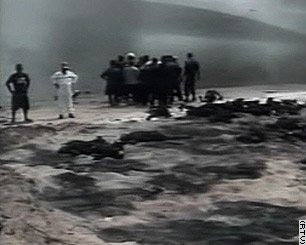
The grim task of identifying the charred bodies of victims of a pipeline explosion that killed at least 150 people this morning awaits rescue crews and investigators. The blast in a village close to the coastal city of Lagos occurred after vandals broke the pipe and villagers rushed to gather the escaping fuel.
Joe Shea/The American Reporter
Investor Plans $350 - $500K Purchase Of ERHE, He Tells ERHC On The Move
An investor who manages about $8 million in securities says he plans to acquire between $350,000 and $500,0000 worth of ERHC Energy shares when the price drops to $0.60, he told ERHC On The Move yesterday.
The caller, who said he is based in Houston, may have begun to buy already, however, as there was a 50,000-share purchase right after the bell yesterday, shortly after we finished talking.
We suggested that the investor average down, as breaking news could propel the stock higher in the near term.
Interested in our outlook on the stock? Drop us a note at amreporter@aol.com. Remember, such advice is purely speculative, and I am not a registered investment advisor.
ERHE's share price fell six cents this morning to $0.66 before recently improving to $0.69, off three cents for the day. Volume remains light at 943,402 at 10:38am EDT.
The caller, who said he is based in Houston, may have begun to buy already, however, as there was a 50,000-share purchase right after the bell yesterday, shortly after we finished talking.
We suggested that the investor average down, as breaking news could propel the stock higher in the near term.
Interested in our outlook on the stock? Drop us a note at amreporter@aol.com. Remember, such advice is purely speculative, and I am not a registered investment advisor.
ERHE's share price fell six cents this morning to $0.66 before recently improving to $0.69, off three cents for the day. Volume remains light at 943,402 at 10:38am EDT.
Breaking News: Many Die In Nigerian Pipeline Blast; Details Sketchy
An explosion in a pipeline in Nigeria's Niger Delta has killed many people, early reports say. A Dow Jones report says thieves and vandals, not ethnic militants, were responsible for rupturing the line.
Here is the first word from the Associated Press:
More information will be provided here as it becomes available.
This was the first word from CNN in a Breaking News bulletin to subscribers at 9:40am EDT:
Here's the latest:
Nigerian violence has been behind much of the recent rise in gasoline and oil prices. More than 600,000 barrels of oil per day were "locked in" due to violence as recently as two weeks ago, but authorities had been able to restore much of that flow. An oil worker was shot dead two days ago in what appeared to be a planned assassination.
The new blast may again focus investor attention on Gulf of Guinea projects that are far from the reach of pipeline thieves, vandals and the Ijaw tribe's coastal guerillas known as MEND (Movement for Emancipation of the Niger Delta).
Those include the recently aswarded Blocks 2, 3 and 4 of the Nigeria-Sao Tome and Principe Joint Development Zone in which ERHC Energy has a major position, along with Anadarko Petroleum (in Block 3), Addax Petroleum and Sinopec (the latter in Block 2 and Addax in Blocks 3 and 4.
Here is the first word from the Associated Press:
LAGOS (AP)--A ruptured pipeline exploded Friday as Nigerian villagers rushed to collect oil gushing from it and "quite a number of people" have perished in the flames, the Nigerian Red Cross said Friday.
Firefighters were on the scene of the explosion at Ilado village about 45 kilometers east of Nigeria's main city of Lagos and Red Cross workers there are helping survivors. "There was a big fire and quite a number of people died," said Okon Umoh, a Red Cross Spokeswoman.
More information will be provided here as it becomes available.
This was the first word from CNN in a Breaking News bulletin to subscribers at 9:40am EDT:
Explosion reported near oil pipeline on outskirts of Lagos, Nigeria, the Nigerian Red Cross tells CNN. There are conflicting reports on casualties.
Here's the latest:
200 Feared Dead in Nigeria Oil Blast
Friday May 12, 9:44 am ET
Oil Pipeline Explodes in Nigeria and Up to 200 Are Feared Dead
LAGOS, Nigeria (AP) -- A ruptured pipeline exploded Friday in southwestern Nigeria as villagers rushed to collect oil gushing from it and a local TV station said up to 200 people were feared dead.
Firefighters were on the scene of the explosion at Ilado, a village about 25 miles east of Nigeria's main city of Lagos, and Red Cross workers were helping survivors.
"There was a big fire and quite a number of people died," Red Cross spokeswoman Okon Umoh said without elaborating.
The blast came as villagers flocked to the ruptured conduit to scoop up fuel that was gushing out. Up to 200 may have perished in the explosion, according to Nigeria's Channels Television.
Nigeria is Africa's leading oil producer, the world's seventh-biggest exporter and fifth-biggest source of U.S. oil imports.
Thieves often steal heavily subsidized fuel from pipelines for personal use or to sell across borders where prices are higher.
In 1998, more than 1,000 villagers died when a ruptured gasoline pipeline exploded as they scavenged fuel.
Nigerian violence has been behind much of the recent rise in gasoline and oil prices. More than 600,000 barrels of oil per day were "locked in" due to violence as recently as two weeks ago, but authorities had been able to restore much of that flow. An oil worker was shot dead two days ago in what appeared to be a planned assassination.
The new blast may again focus investor attention on Gulf of Guinea projects that are far from the reach of pipeline thieves, vandals and the Ijaw tribe's coastal guerillas known as MEND (Movement for Emancipation of the Niger Delta).
Those include the recently aswarded Blocks 2, 3 and 4 of the Nigeria-Sao Tome and Principe Joint Development Zone in which ERHC Energy has a major position, along with Anadarko Petroleum (in Block 3), Addax Petroleum and Sinopec (the latter in Block 2 and Addax in Blocks 3 and 4.
Thursday, May 11, 2006
ERHC Asks SEC For 5-Day Delay In Filing 10Q
Citing "impractible" constraints on time to collect the information required, ERHC Energy has filed an NT-10Q to ask for an additional five days to file its full quarterly report, which was due today.
Here is the explanation taken from ERHC's request to the SEC:
Here is the explanation taken from ERHC's request to the SEC:
The compilation, dissemination and review of the information required to be presented in the Form 10-Q for the relevant period has imposed time constraints that have rendered timely filing of the Form 10-Q impracticable without undue hardship and expense to the registrant. The registrant undertakes the responsibility to file such report no later than five days after its original prescribed due date.
Dow Jones Was Unaware Sao Tome Report Was Rejected In Entirety By Both Governments
The reporter who wrote the May 5 Dow Jones story about service of a search warrant at ERHC Energy's Houston, Texas, headquarters on Thursday, May 4, were unaware until ERHC On The Move told them about it that both governments had rejected the report "in its entirety" in a formal resolution adopted Feb. 8 and released to the public on its Websiote on Feb. 9, 2006.
Update, 2:45pm, 05/11/06: A caller from Dow Jones named Nancy Jankelowski (or something like that) who supervises the editor and reporter said the company will not correct the misinformation it published on May 5. She hung up on us when we tried to press our case, saying that not reporting that the Sao Tome Atty. General's report was rejected is like reporting an indictment and then not reporting the indictment has been quashed.
The editor in the Dow Jones Washington bureau said the matter will be taken up with his editor, and he indicated that a response will be forthcoming from the company.
The editor also indicated that the story had faithfully reported the content of statements in a commentary about the billion-barrel discovery in Block 1 (adjoining ERHC Energy's equity in Block 2) by a Wall Street Journal in March, in which the writer also failed to mention the official government rejection of the report.
Update, 2:45pm, 05/11/06: A caller from Dow Jones named Nancy Jankelowski (or something like that) who supervises the editor and reporter said the company will not correct the misinformation it published on May 5. She hung up on us when we tried to press our case, saying that not reporting that the Sao Tome Atty. General's report was rejected is like reporting an indictment and then not reporting the indictment has been quashed.
The editor in the Dow Jones Washington bureau said the matter will be taken up with his editor, and he indicated that a response will be forthcoming from the company.
The editor also indicated that the story had faithfully reported the content of statements in a commentary about the billion-barrel discovery in Block 1 (adjoining ERHC Energy's equity in Block 2) by a Wall Street Journal in March, in which the writer also failed to mention the official government rejection of the report.
Dow Jones Reports On Warrant Search; No Mention Of Rep. Jefferson
Rumors on the message boards this morning that the ERHC warrant concerned only Rep. William Jefferson were not confirmed by a Dow Jones story out this morning, which says only what the company said in its Friday press release about last Thursday's service of a search warrant at the company's Houston, Texas headquarters.
Here is the Dow Jones story:
Here is the Dow Jones story:
WASHINGTON (Dow Jones)--ERHC Energy Inc. (ERHE) disclosed Friday that it received a search warrant from a Texas court seeking information related to the company's relationships in Sao Tome and Nigeria.
According to a document filed by the independent oil and gas company with the Securities and Exchange Commission, the U.S. District Court of the Southern District of Texas, Houston Division, executed the search warrant Thursday.
ERHC, based in Houston, said the court sought various records including documents related to correspondence with foreign governmental officials or entities.
The company said it cooperated fully with the government regarding this matter.
The filing didn't provide further information.
According to a Wall Street Journal article in March, Sao Tome's attorney general singled out ERHC for special scrutiny in an investigation, alleging it may have provided bribes to hold on to longstanding exploration rights it won in the late 1990s.
Sao Tome's attorney general forwarded the report to Nigerian authorities and to the SEC and the U.S. Justice Department.
ERHC shares trade on the OTC Bulletin Board, but its majority shareholder is a Nigerian oil concern.
-By Chad Clinton, Dow Jones Newswires; 202-862-1349;
chad.clinton@dowjones.com
(END) Dow Jones Newswires
05-05-06 0757ET
07:57 050506
'Tight Holes Are Kept Tight,' Chevron Figure Says
A Chevron employee who will remain anonymous responded today to our questions about its Block 1 discovery with a statement that is reminiscent of comments by one oil company in the 1980's regarding a big North Sea find: "It's a competitive business."
Judging by that, investors who are waiting for a blockbuster announcement from Chevron about the find may be disappointed. The company has little obligation to share its good news with anyone else, and certainly not with competing oil firms.
Indeed, the best that we can hope for may be an announcement from the Nigerian side of the Nigeria-Sao Tome and Principe Joint Development Authority, which does tend to leak but only very rarely leaks accurate information.
As you know this is a competitive business and tight holes are kept tight ... Remember Chevron's North Slope well in Alaska near ANWAR in the 1980's? I think aspects of that well are still tight.
Judging by that, investors who are waiting for a blockbuster announcement from Chevron about the find may be disappointed. The company has little obligation to share its good news with anyone else, and certainly not with competing oil firms.
Indeed, the best that we can hope for may be an announcement from the Nigerian side of the Nigeria-Sao Tome and Principe Joint Development Authority, which does tend to leak but only very rarely leaks accurate information.
Illinois Researcher Discovers 225-Million-Barrels Of Oil (In A Pig's Ass)
Pardon the vulgarity, but a University of Illinois researcher who spent 10 years working on the project has found a way to turn pig crap into diesel fuel at the rate of 3.6 gallons per day per pig. There's 7.2 million hogs in Illinois, so the potential is there for more than 9.46 billion gallons of crude, or 225 million barrels, every year.
Naturally, one guy has 500,000 gallons of pig manure ready to process through Prof. Yuanhui Zhang's continuous reactor, which replaces a bucket-by-bucket method. That's $450,000 at today's price of $73 a barrel.
As one who shoveled endless barrels of the stuff on Becky Bentley's Ramblo'er Farm down in Marietta, Ga., as a kid, I can tell you I would not want to be the one that feeds into the reactor. But since I was only paid $2 a week (and $5 a week during the summer) for that work, I would certainly enjoy the income... .
Naturally, one guy has 500,000 gallons of pig manure ready to process through Prof. Yuanhui Zhang's continuous reactor, which replaces a bucket-by-bucket method. That's $450,000 at today's price of $73 a barrel.
As one who shoveled endless barrels of the stuff on Becky Bentley's Ramblo'er Farm down in Marietta, Ga., as a kid, I can tell you I would not want to be the one that feeds into the reactor. But since I was only paid $2 a week (and $5 a week during the summer) for that work, I would certainly enjoy the income... .
ILLINOIS STYLE: UI researcher makes crude oil from pig manure
DAVE ORRICK
(Arlington Heights) Daily Herald
HAMPSHIRE, Ill. - Can the other white meat's manure make black gold?
They say you can't turn a sow's ear into a silk purse, but University of Illinois researchers are working some interesting magic at the other end of the animal.
"We are the first to actually do this," professor Yuanhui Zhang says proudly of his team's ability to turn swine manure into crude oil. He's a bio-environmental engineer at the University of Illinois Urbana-Champaign who has led the 10-year research project that recently announced a breakthrough in porcine petroleum.
That neat trick may sound crude.
But it also sounds good to a pork industry swamped with oceans of swine manure, and it sounds like the national anthem to those looking to reduce America's dependence on foreign oil.
A typical pig produces about 6 gallons of waste a day.
For a hog farmer like Pat Dumoulin of Hampshire, who has about 1,200 sows, that's enough stinky and potentially hazardous fumes that he has a pair of 500,000-gallon tanks to properly store the stuff.
Like most farmers, much of the manure from Dumoulin's hogs winds up as fertilizer.
"Most of the farmers in our area are open to taking the hog manure," says Dumoulin, whose farm has been in his family for more than 50 years. "Sometimes it's done for no cost, sometimes they pay us a fee to spread it on their fields."
Either way, scientists have agreed for years that the chemical and capital potential of pig manure, like almost all organic waste, could have other uses.
Zhang's breakthrough wasn't that he and fellow researchers had become excrement alchemists; in about 1998, he figured out how to convert some of a pig's byproduct to an energy source. Turning garbage into natural gas, cow manure into fuel for power plants, and even fast-food grease into auto fuel are other examples of recent advances in the sub-field of icky-but-renewable energy.
Zhang's big breakthrough is that he's designed a more efficient process: a continuous reactor. Instead of converting hog waste one batch at a time, Zhang's lab, which is funded in part by the Illinois Pork Producers Association, has developed a method to feed waste continuously into a reactor, which is essentially an industrial-strength pressurized oven. And, Zhang boasts, "We don't even need pre-drying."
Chemically, pig dung isn't as different from oil as one might think. In Zhang's reactor, a process known as thermochemical conversion partially breaks down hydrocarbon molecules that make up most of the excrement, and voila: porky petrol.
Similar but not identical to the black gold it took Mother Nature eons to brew, Zhang's fuel behaves like diesel.
Now the plan is to move from the lab to a full-sized pilot reactor on a farm somewhere Downstate. Zhang predicts the process could get 3.6 gallons of crude oil a day out of each pig. Illinois brings some 7.2 million hogs to market each year and the nationwide industry is about 100-million hogs strong.
Theoretically, the resulting millions of barrels of crude a day could make a significant dent in America's dependence on nonrenewable, and often imported, oil.
But converting the nations automobile fleet to hog-oline isn't what Zhang or the hog industry is thinking about right now. No research has been done into how many current commercial vehicles could run on the fuel.
Chavez Doubles Royalty On Oil
Big producers who now pay a 16.67 percent royalty on oil will see their tax obligation rise to 33 percent under a new law there, and that may be yet another reason the nine blocks of the Nigeria-Sao Tome and Principe Joint Development Zone look attractive to the majors.
According to a Dow Jones report, the hike in royalties comes with a stiff jump in income taxes, too, from 34 percent to 50 percent. The latter is the same rate such companies now pay in the JDZ - minus the political uncertainty.
Here is an excerpt from this morning's report:
According to a Dow Jones report, the hike in royalties comes with a stiff jump in income taxes, too, from 34 percent to 50 percent. The latter is the same rate such companies now pay in the JDZ - minus the political uncertainty.
Here is an excerpt from this morning's report:
CARACAS (Dow Jones)--Venezuela's Council of Ministers formally approved a 33.3% royalty for domestic oil production, doubling the rate at four large
projects with multinational oil companies, reported the ABN state news agency late Monday.
President Hugo Chavez announced the new royalty, or "extraction tax", over the weekend. The tax is applied to volumes of oil production at the well-head, not profits. Earlier on Monday, Oil Minister Rafael Ramirez said the tax will come into effect after approval by the National Assembly, which is 100% controlled by Chavez supporters.
Venezuela already hiked the royalty rate for one fifth of the nation's oil production to 33.3% earlier this year as part of a contract overhaul where state firm Petroleos de Venezuela S.A. (PVZ.YY) took majority control of 32 oil fields that were previously operated independently under contract.
PdVSA, as the state firm is known, currently pays a 30% royalty on oil production, which it will have to raise by 3.3 percentage points when the new law comes into effect. Four heavy oil projects where multinational firms like Conoco (COP) and Chevron Corp. (CVX) pump 600,000 barrels a day will have to double their current royalty payments of 16.67%. According to Ramirez, the royalty hike and an income tax hike to 50% from 34% for these heavy oil projects will generate an additional $2 billion a year in revenue for the state.
Monday, May 08, 2006

Friday, May 05, 2006
Justice Dept. Investigating ERHC, Company 8K Indicates
Shades of Dobie Langenkamp!
Alleged company payments to Sao Tomean and Nigerian officials are under investigation by the FBI and the Dept. of Justice, an 8K report filed with the SEC last Thursday indicates.
In response, shares of ERHE fell to $0.68 before recovering to $0.81. There was no public comment from the company.
Shares opened Monday at $0.82 and have traded as low as $0.75 before beginning to climb once again, probably in anticipation of a fruitless investigation whose aims have already been rejected by the highest officials of both governments this year, and the probability that a portion of a Chevron discovery in adjoining Block 1 will vastly increase the value of ERHC Energy's Block 2 due to a substantial "straddle" of both blocks.
The straddle has been rumored but not yet announced by Chevron, which is historically closed-mouthed about its discoveries and their potential. OPEC President Edmund Daukoru has said the find may have to be revised upwards from the billion-barrel level, however. He is also oil minister of Nigeria.
The apparent Dept. of Justice probe, which would probably be conducted under the provisions of the Foreign Corrupt Practices Act (FCPA), is unrelated to a pending case against Chevron, ExxonMobil, Devon Energy and Noble Energy, among others, arising from alleged payments for oil leases to officials of Equatorial Guinea. After hearing some testimnony, the pro-oil Senate Commerce Committee chaired by Alaska Republican Sen. Ted Stevens has sat on that probe for years.
According to information received by ERHC On The Move, however, there may a connection between the search warrant served yesterday and an investigation into the bribery allegations concerning Rep. William Jefferson, Democrat of Louisiana.
This blog has received several requests for information in association with that investigation from Washington-based investigative reporters, who have focused their inquiries on ERHC Energy investor Phil Nugent. It is not known whether Nugent or Jefferson is a target of the current investigation.
Here is the document filed:
Alleged company payments to Sao Tomean and Nigerian officials are under investigation by the FBI and the Dept. of Justice, an 8K report filed with the SEC last Thursday indicates.
In response, shares of ERHE fell to $0.68 before recovering to $0.81. There was no public comment from the company.
Shares opened Monday at $0.82 and have traded as low as $0.75 before beginning to climb once again, probably in anticipation of a fruitless investigation whose aims have already been rejected by the highest officials of both governments this year, and the probability that a portion of a Chevron discovery in adjoining Block 1 will vastly increase the value of ERHC Energy's Block 2 due to a substantial "straddle" of both blocks.
The straddle has been rumored but not yet announced by Chevron, which is historically closed-mouthed about its discoveries and their potential. OPEC President Edmund Daukoru has said the find may have to be revised upwards from the billion-barrel level, however. He is also oil minister of Nigeria.
The apparent Dept. of Justice probe, which would probably be conducted under the provisions of the Foreign Corrupt Practices Act (FCPA), is unrelated to a pending case against Chevron, ExxonMobil, Devon Energy and Noble Energy, among others, arising from alleged payments for oil leases to officials of Equatorial Guinea. After hearing some testimnony, the pro-oil Senate Commerce Committee chaired by Alaska Republican Sen. Ted Stevens has sat on that probe for years.
According to information received by ERHC On The Move, however, there may a connection between the search warrant served yesterday and an investigation into the bribery allegations concerning Rep. William Jefferson, Democrat of Louisiana.
This blog has received several requests for information in association with that investigation from Washington-based investigative reporters, who have focused their inquiries on ERHC Energy investor Phil Nugent. It is not known whether Nugent or Jefferson is a target of the current investigation.
Here is the document filed:
Item 8.01 Other Events
On May 4, 2006, a search warrant issued by the U.S. District Court of the Southern District of Texas, Houston Division, was executed on ERHC Energy Inc. ("Company") for various records including, among other matters, documents related to correspondence with foreign governmental officials or entities in Sao Tome and Nigeria. The Company cooperated fully with the government in respect to this matter.
SIGNATURES
Pursuant to the requirements of the Securities Exchange Act of 1934, the registrant has duly caused this report to be signed on its behalf by the undersigned hereunto duly authorized.
ERHC Energy Inc.
By: /s/ Walter F. Brandhuber
-------------------------
Walter F. Brandhuber, President
DATE: March 4, 2006
Signature Bonuses Trigger $45 Million In Payments For ERHC
A JDA press release says Nigeria and Sao Tome have received $145 million in Joint Development Zone signature bonus fees for rights to Blocks 2, 3 and 4. The payments also triggered payments of some $45 million to ERHC Energy and an 8 percent run-up in share price:
RE: THE 2ND (2004) LICENSING ROUND OF
THE NIGERIA-SAO AND PRINCIPE JOINT DEVELOPMENT ZONE.
PAYMENT OF SIGNATURE BONUS IN RESPECT OF JDZ BLOCKS 2, 3,
AND 4 BY CONTRACTOR PARTIES.
Pursuant to Clauses 2.1 and 30.1(a) of the Production Sharing Contracts (PSC) signed between the JDA and Contractor Parties in respect of Blocks 2, 3 & 4 of the JDZ, the JDA, on behalf of the State Parties, has received from the Contractor Parties, the total sum of U.S. $145,649,647.00 (one hundred and forty-five million, six hundred and forty-nine thousand, six hundred and forty-seven United States’ Dollars) as Signature Bonus payments.
NIGERIA-SAO TOME & PRINCIPE
JOINT DEVELOPMENT AUTHORITY
ABUJA, NIGERIA.
May 3, 2006
Thursday, May 04, 2006
MEND Says It's Not Behind Attacks On ExxonMobil
The Movement for the Emancipation of the Niger Delta (MEND, which is a strange name for an organization that does little but destroy) today disclaimed responsibility for attacks on ExxonMobil facilities in Nigeria's oil-rich Delta region where most production has been suspended since Wednesday, the Dow Jones news agency reported.
Here is the latest on those attacks, which the agency says were committed by unidentified "youths":
Here is the latest on those attacks, which the agency says were committed by unidentified "youths":
LAGOS (Dow Jones) -- Militants belonging to the Movement for the Emancipation of the Niger Delta have dissociated themselves from recent attacks on facilities belonging to Mobil Producing Nigeria Unlimited, a unit of ExxonMobil Corp. (XOM).
"We were not involved in the so-called attacks," MEND said Thursday in an email to Dow Jones Newswires. "By now it should be clear that when we attack, a confirmation from this site is just a formality."
Youths in Ebeno, a community in Eket in southern Nigeria, attacked Mobil's Qua Iboe Terminal Tuesday, forcing the company to temporarily halt operations there.
ExxonMobil has been running skeletal services since Wednesday. "It means that if previously you had 500 people working there, now you have just 10% of that," an oil industry union leader said.
He said the management of ExxonMobil wanted to establish what the motives behind the attack were through ongoing talks with leaders of Ebeno before workers would be allowed to return.
Previously, MEND had threatened to attack ExxonMobil over the company's alleged failure to pay compensation for an oil spill it caused in 1998 in an Ijaw community.
MEND claimed responsibility for two recent bomb blasts in the Niger Delta. The first, at a military base in Port Harcourt, killed three people in a car and wounded others. The latest, which occurred Saturday in Warri, also involved a car parked near gasoline tankers waiting to take delivery of products from the Warri Refinery.
-By Vincent Nwanma, Dow Jones Newswires; +234-1-585-0849;
vinwanma@beta.linkserve.com
(END) Dow Jones Newswires
05-04-06 1112ET
11:12 050406
Wednesday, May 03, 2006
ERHE Jumps $0.07, Or 8%, In Sudden Sport
For no apparent reason except possibly a large Buy order, ERHE shares jumped 8.41 percent in a matter of minutes this morning, only to fall back to $0.83 - still a $0.04 gain. No great volume spike accompanied the surge; volume afterwards stood at 679,420.
The possibility that Doc's prediction of big news this week relative to a deal between ERHC Energy and an unidentified Chinese firm was one possible reason for the short-lived spike.
Trading stood at $0.82 at 9:37am EDT and shot up to $0.88 by 10:13, when it began to fall. About 562,000 shares traded in that time.
Stop the presses! That price and volume spike has resumed. We cannot find any news via several sources that ought to have it, if there were any, so we suspect a stock tip newsletter has recommended a buy based on technical data, which is reportedly looking strong for ERHE. Please let me know if you have heard anything at amreporter@aol.com. Just click on the envelope below, and thanks!
At 10:47am EDT, the price is $0.88 and the Bid is $0.875. Volume stands at 1,187,485, a substantial jump over the past half hour.
The possibility that Doc's prediction of big news this week relative to a deal between ERHC Energy and an unidentified Chinese firm was one possible reason for the short-lived spike.
Trading stood at $0.82 at 9:37am EDT and shot up to $0.88 by 10:13, when it began to fall. About 562,000 shares traded in that time.
Stop the presses! That price and volume spike has resumed. We cannot find any news via several sources that ought to have it, if there were any, so we suspect a stock tip newsletter has recommended a buy based on technical data, which is reportedly looking strong for ERHE. Please let me know if you have heard anything at amreporter@aol.com. Just click on the envelope below, and thanks!
At 10:47am EDT, the price is $0.88 and the Bid is $0.875. Volume stands at 1,187,485, a substantial jump over the past half hour.
Tuesday, May 02, 2006
National Public Radio Notes Chevron Block 1 Find; CVX Conference Call Coming?
National Public Radio has a story out on the global search for oil this morning, and the very first words out of the narrator's mouth concern a billion-barrel find by Chevron at its Obo-1 well in Block 1 of the Nigeria-Sao Tiome and Principe Joint Development Zone.
You can hear it at: http://www.npr.org/templates/story/story.php?storyId=5374852
Exciting as it may be, though, investors who sold ERHE this morning to buy PGPM, a Pink Sheets stock, are the ones doing the celebrating. The stock jumped 900 percent top $0.11 yesterday on 75 million shares of volume - about a quarter of its 325 million float - and was up 170 percent to $0.28 this morning!
The company, a little-known outfit called Pilgrim Petroleum, said it has acquired leases for 12,000 acres of properties in Texas that may hold some 900 million barrels of reserves in shale.
Wish you were there? Too late now, as it's fallen back to $0.18 - on 25 million shares of volume at 10:45am EDT.
Meanwhile, Chevron is up $0.65, and ERHE shares jumped on the news from $0.77 to $0.83 before sliding back to $0.815 at 10:37am EDT. Update, 10:54am EDT: We hear that a conference call from Chevron on the find is now in the workls. No date or time info, though.
You can hear it at: http://www.npr.org/templates/story/story.php?storyId=5374852
Exciting as it may be, though, investors who sold ERHE this morning to buy PGPM, a Pink Sheets stock, are the ones doing the celebrating. The stock jumped 900 percent top $0.11 yesterday on 75 million shares of volume - about a quarter of its 325 million float - and was up 170 percent to $0.28 this morning!
The company, a little-known outfit called Pilgrim Petroleum, said it has acquired leases for 12,000 acres of properties in Texas that may hold some 900 million barrels of reserves in shale.
Wish you were there? Too late now, as it's fallen back to $0.18 - on 25 million shares of volume at 10:45am EDT.
Meanwhile, Chevron is up $0.65, and ERHE shares jumped on the news from $0.77 to $0.83 before sliding back to $0.815 at 10:37am EDT. Update, 10:54am EDT: We hear that a conference call from Chevron on the find is now in the workls. No date or time info, though.
Subscribe to:
Posts (Atom)
